September 1921. The SS Narkunda is crossing the Mediterranean, England to Bombay by way of Suez.
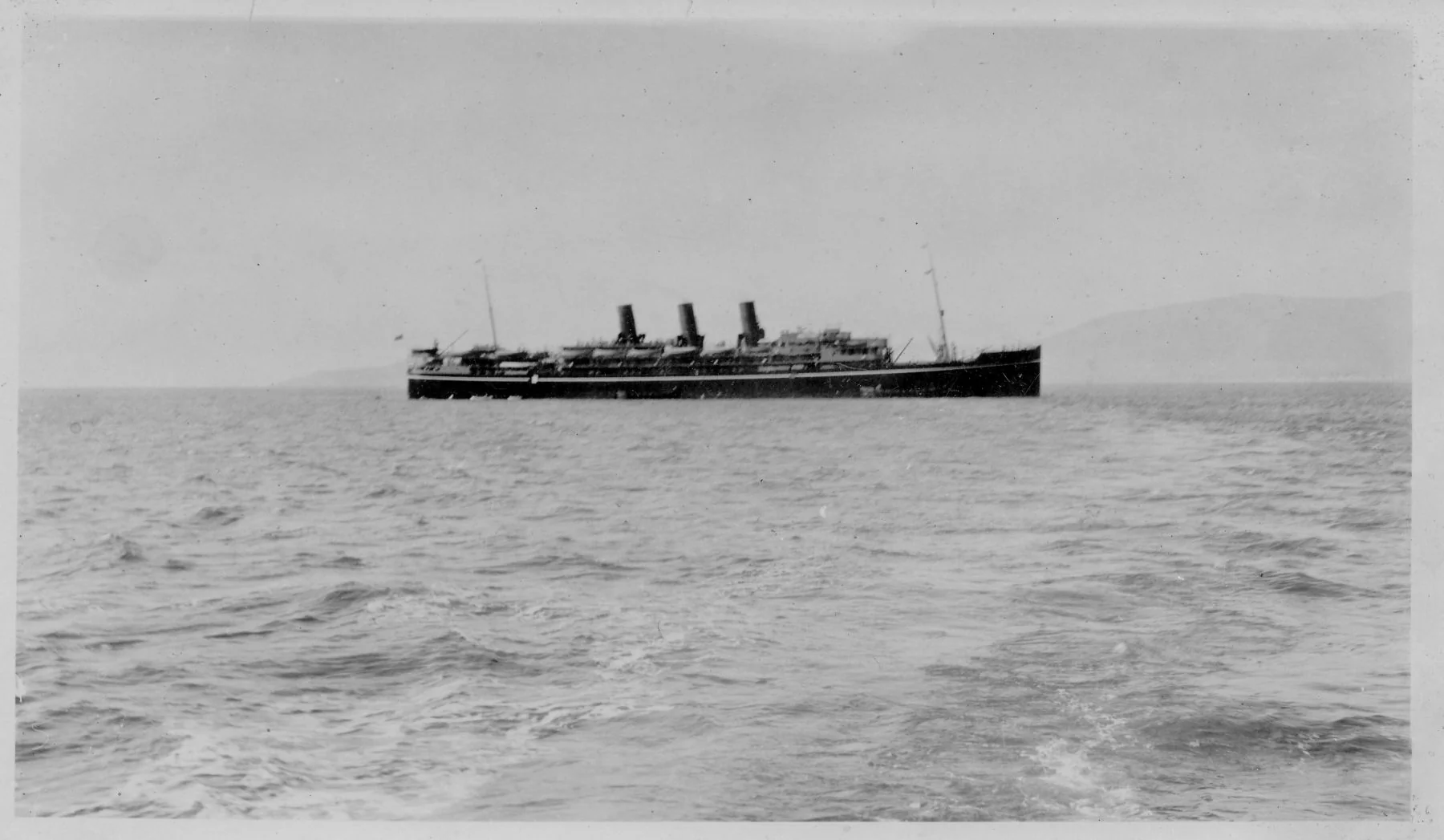
Narkunda lying off Gibraltar, at the western gate of the Mediterranean, 1929–30. From J. Leo Mason’s photographs of a 1929–30 Queensland Railways study tour; scan by John Robert McPherson. Image record. Scan released under CC0.
A man in a turban stands at the rail with a Nicol prism held to his eye. He is a thirty-two-year-old physics professor from Calcutta, on his first trip abroad. He is looking at the water.
Lord Rayleigh had explained the colour of the sea in 1910. Its much-admired blue, he wrote, was the sky, seen by reflection.
The prism is a way of checking. Light that bounces off a surface at a certain angle comes back polarised, and a Nicol prism turned the right way blocks it. Cut out the reflected sky and, if Rayleigh was right, the sea should go grey.
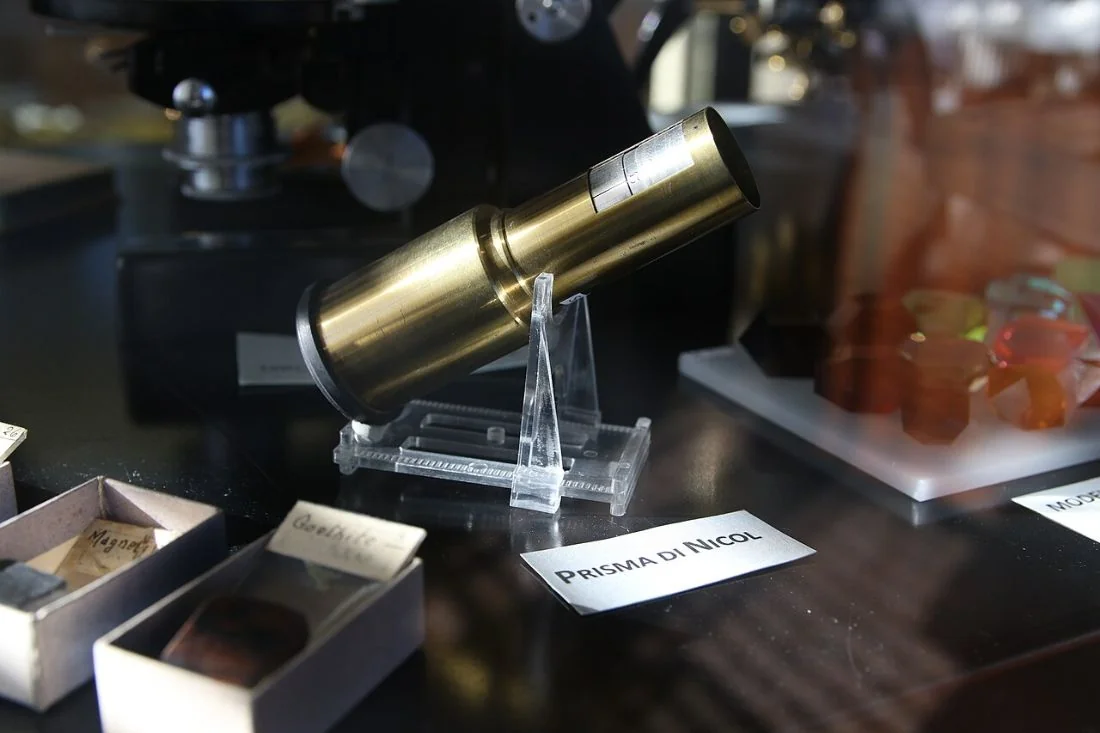
A Nicol prism of the kind Raman used on the Narkunda. Mineralogical collection of the Luigi Bombicci Museum, University of Bologna. Photograph by Patafisik, 2023. Image record. CC BY-SA 4.0.
He turned the prism. The sea stayed blue.
C. V. Raman wrote it up before the ship docked. The water, he reported, was so full and saturated a blue that the bluest sky beside it looked a dull grey. The colour was coming from inside the sea. Light was going into the water and something in the water was sending it back.
The deep blue is “a distinct phenomenon in itself, and not merely an effect due to reflected skylight.”
EXHIBIT AThe letter, signed in Bombay Harbour. Re-typeset by Pharmakon from the published letter. Highlight ours. Paper.
He went home and spent the next seven years on that something.
This edition has no drug in it. It is about the test that tells one substance from another, and who owns the machines that run it.
Pharmakon follows what people put into bodies and who decides what is allowed in. Every one of those decisions starts with knowing what is actually in the vial.
The remedy and the poison can look the same. So can a diamond dug from a kimberlite pipe in Africa and one grown in a reactor in Surat last month. The eye cannot tell either pair apart.
Raman scattering identifies substances through their vibrational spectra. Telling a mined diamond from a grown one requires further tests of its defects and growth structure.
The effect is free to use. Many commercial readers pair proprietary instruments with licensed reference libraries. Open collections exist too, including RRUFF’s mineral spectra. They do not by themselves provide a validated testing service.
The accountant’s nights
In June 1907 Raman arrived in Calcutta as Assistant Accountant General in the Finance Department. He was eighteen. He had come first in the Finance Department’s competitive examination. Paid research posts in physics barely existed in India, so the young physicist became a civil servant.
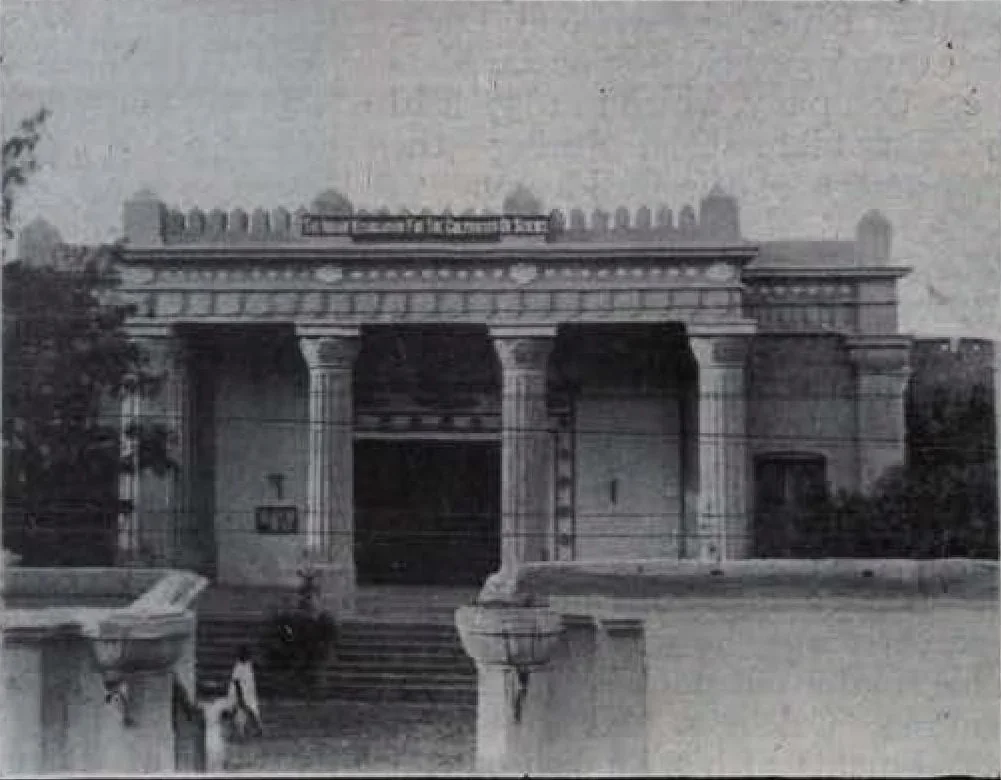
The Indian Association for the Cultivation of Science, Bowbazar, as photographed for The Cyclopedia of India in 1908, a year after Raman arrived in Calcutta. Image record. Public domain.
He and his wife rented a house in Scots Lane, off Bowbazar Street. A few days in, riding the tram to the office, he saw a signboard at 210 Bowbazar Street for the Indian Association for the Cultivation of Science.
The physician Mahendralal Sircar had founded it in 1876 to do original research. Mostly it had hosted public lectures. It had a hall, a laboratory and a good deal of demonstration apparatus that nobody used.
Raman walked in and asked to use the laboratory.
His biographer and former student P. R. Pisharoty records the routine that followed. He reached the Association at 5.30 in the morning and worked until 9.45, then went home to eat and on to the office. After office hours he went straight back to the laboratory and stayed until about ten at night. He spent Sundays there too. p. 12
EXHIBIT BRaman’s first letter to Nature, sent four months after he joined the Finance Department, from the laboratory on Bowbazar Street. Re-typeset by Pharmakon from the published letter. Highlight ours. Paper.
He worked with one assistant, Ashutosh Dey, whom everyone called Ashu Babu. Dey had never been to a university. Over the next decade Raman published around thirty papers from that laboratory, on Indian drums and stringed instruments and on the diffraction of light, many with Dey as co-author. Raman was proudest of one in the Proceedings of the Royal Society with Dey as its only author. p. 13
Posted briefly to Nagpur, Raman was brought a bundle of hundred-rupee notes, half-burnt in a fire. The owner wanted them replaced. Raman went through the charred scraps, recovered the numbers and markings, satisfied himself the notes were genuine, and told the treasury to pay. p. 14
Asutosh Mookerjee, vice-chancellor of the University of Calcutta, asked the government to lend Raman to the university for two years. The Finance Member of the Viceroy’s Council refused.
“I find that (Mr. Venkata Raman) is most useful in the Finance Department, being in fact one of our best men.”
Mookerjee offered him the new Palit Chair of Physics instead. In 1917 Raman resigned from government service and took it, on a lower salary. Of his years in Calcutta, the historian Jahnavi Phalkey counts ten as an accountant who did his research before and after office hours.
Later he rented the house next to the Association and had part of the dividing wall knocked through, so he could walk into the laboratory at any hour of the day or night. pp. 16, 23 His students kept their bedding in corners of the lab and slept between experiments.
A flask of benzene
The trouble started in April 1923. K. R. Ramanathan, Raman’s most gifted student, was sending filtered sunlight through water. One filter selected a narrow band of sunlight. He viewed the scattered light through a second filter that blocked that band.
A faint track still glowed in the liquid.
It looked like fluorescence from some impurity. So he distilled the water slowly under vacuum, then distilled it again. The glow stayed, so it had to come from the water itself. In his Nobel lecture Raman put its strength at a few hundredths of the already feeble ordinary scattering.
For five years the laboratory at Bowbazar chased it. K. S. Krishnan found it in many other liquids. S. Venkateswaran reported that sunlight scattered by purified glycerine came out a brilliant green instead of blue. In 1927 the Association acquired a seven-inch refracting telescope. With a short-focus lens, its objective worked as a burning glass and squeezed sunlight into a thin, intense pencil.
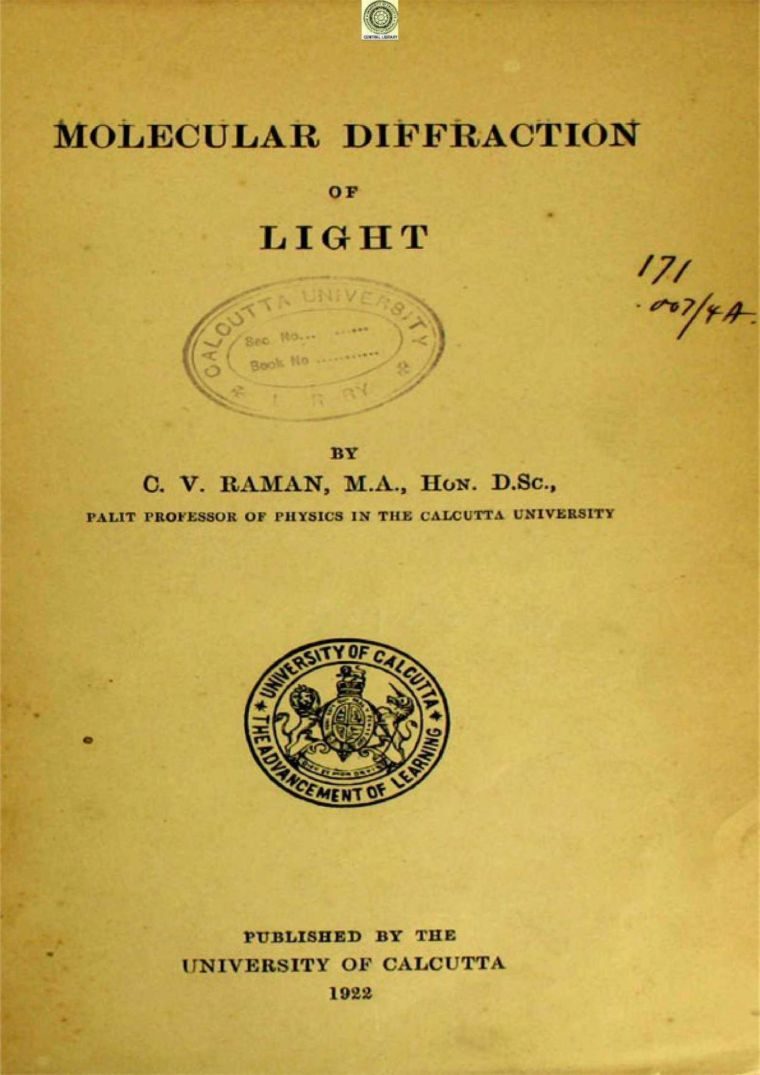
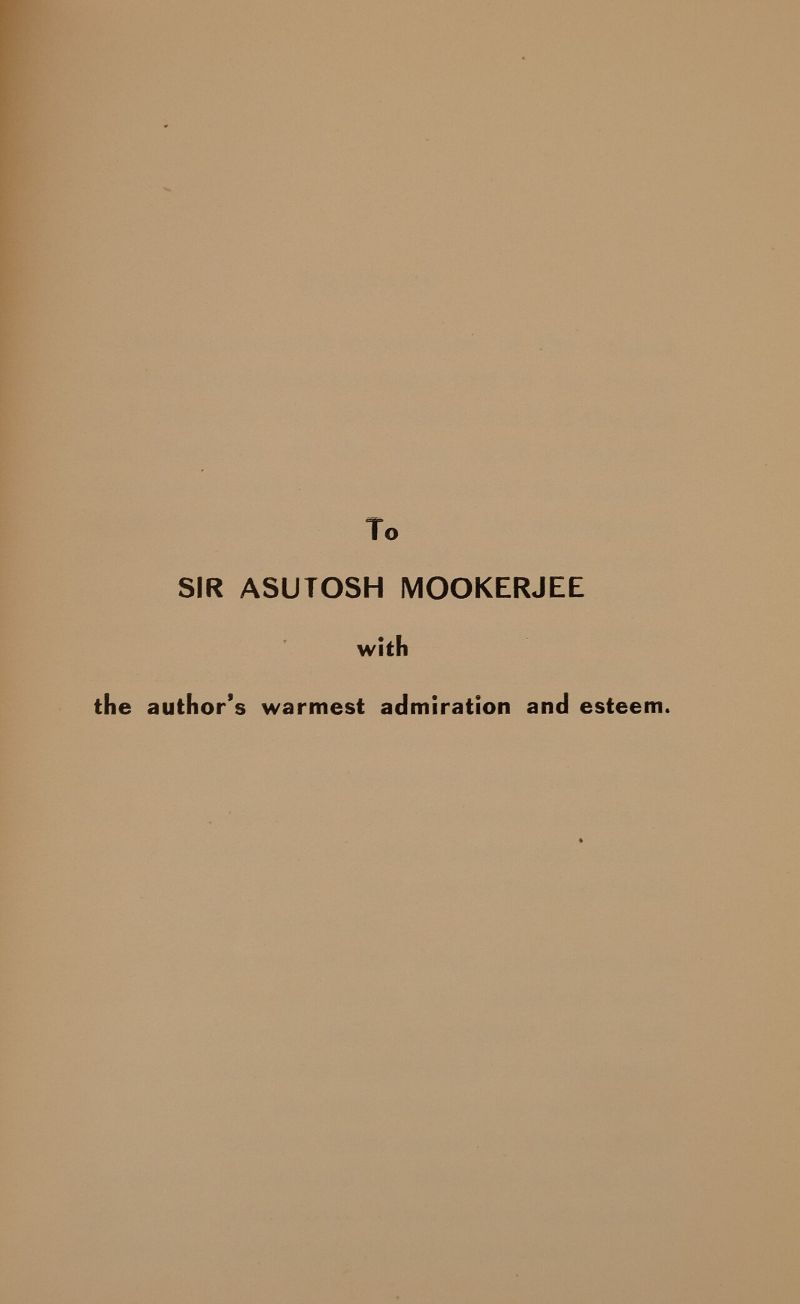
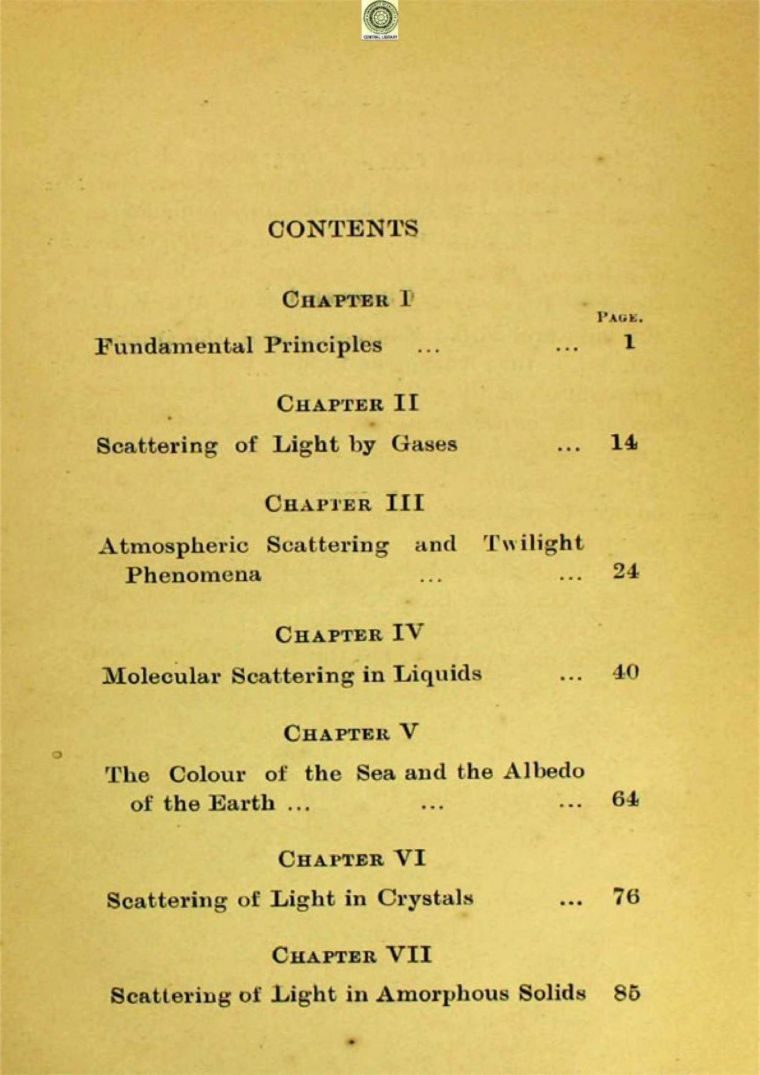
Raman’s 1922 monograph, written within months of the voyage. Molecular Diffraction of Light, University of Calcutta, 1922. Title page; the dedication to Asutosh Mookerjee, from a copy in the Niels Bohr Library & Archives, American Institute of Physics; contents, with the colour of the sea at chapter V. Internet Archive scan and dedication record. Public domain in the United States.
On 16 February 1928 Raman and Krishnan sent a letter to Nature announcing “a new type of secondary radiation”. The letter described complementary colour filters and also reported spectroscopic confirmation. Journey into Light, pp. 206–207
On 28 February, Raman and Krishnan examined the scattered light through a direct-vision spectroscope. Krishnan’s diary records a band separated from the incident light by a dark interval. The discovery was announced the following day. Journey into Light, pp. 197–198
In his Nobel lecture, Raman described how observations with filtered sunlight led him to use a mercury arc. Its scattered light revealed sharp new lines absent from the lamp’s own spectrum. Further measurements made those shifts a way of reading the substance that scattered the light. Nobel lecture, pp. 271–273
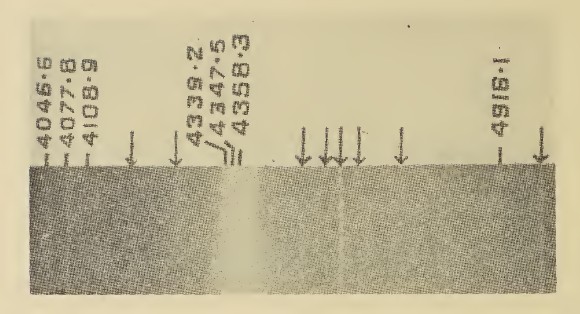
Light scattered by benzene, photographed in Calcutta in 1928. The numbers along the top are the mercury lamp’s own lines, in ångströms. The arrows mark lines the lamp does not contain. Published by Raman and Krishnan, 1929, according to the image record. Raman and Krishnan; reproduced here for discussion of the recorded spectrum.
Pisharoty puts the cost of the apparatus at under 200 rupees: a mercury lamp and a hand spectroscope, pointed at a flask of benzene. pp. 25–26 The first photographs were taken on a Hilger “Baby” quartz spectrograph, the smallest the London firm made, as Raman told the Nobel audience.
India now marks 28 February as National Science Day.
“The essence of science is independent thinking, hard work and not expensive equipment.”
Moscow, a week earlier
On 21 February 1928, Grigory Landsberg and Leonid Mandelstam at Moscow State University photographed the same kind of new lines in light scattered by crystals of quartz. Their crystal scattered so weakly that a single exposure ran about fifteen hours.
They presented it at a Moscow meeting in April and published in July. By then Raman had put out a paper in the Indian Journal of Physics and mailed at least 1,000 reprints to laboratories across Europe and North America.
One of the nominations for the 1930 Nobel Prize named Raman, Landsberg and Mandelstam together. The committee gave it to Raman alone. He was confident enough to have booked his passage to Stockholm in July, months before the announcement. p. 26

A Soviet postal envelope honouring the academician G. S. Landsberg, 1890–1957. USSR Post. Image record. Public domain.
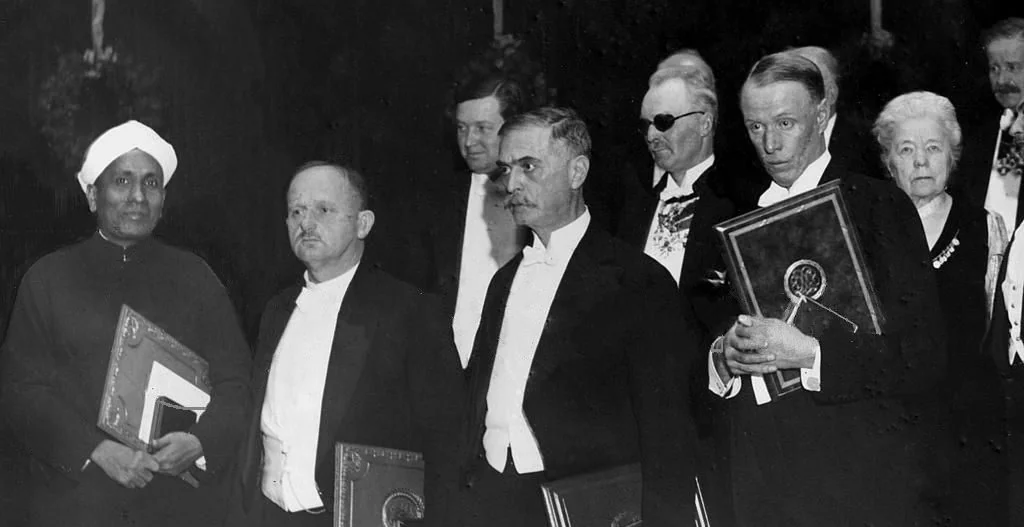
December 1930. From left, Raman (physics), Hans Fischer (chemistry), Karl Landsteiner (medicine) and Sinclair Lewis (literature). TT Nyhetsbyrån. Image record. Public domain.
Raman was named for the 1957 Lenin Peace Prize and travelled to Moscow to receive it in 1958. A. Jayaraman, who worked at Raman’s institute in the 1950s and later wrote a memoir of him, writes that remarks at the ceremony apparently suggested Landsberg and Mandelstam had found the effect at the same time and deserved equal credit. Raman said later that he should not have accepted. Jayaraman, p. 134
Jayaraman believed the nomination began with Major General Sahib Singh Sokhey, the former director of the Haffkine Institute, who had been awarded the Stalin Peace Prize for 1953 and had visited Raman’s institute. Jayaraman presents this as his own guess. p. 133
Russian physics kept its own name for the effect. In Russian textbooks the effect is still kombinatsionnoye rasseyaniye sveta, combination scattering of light.
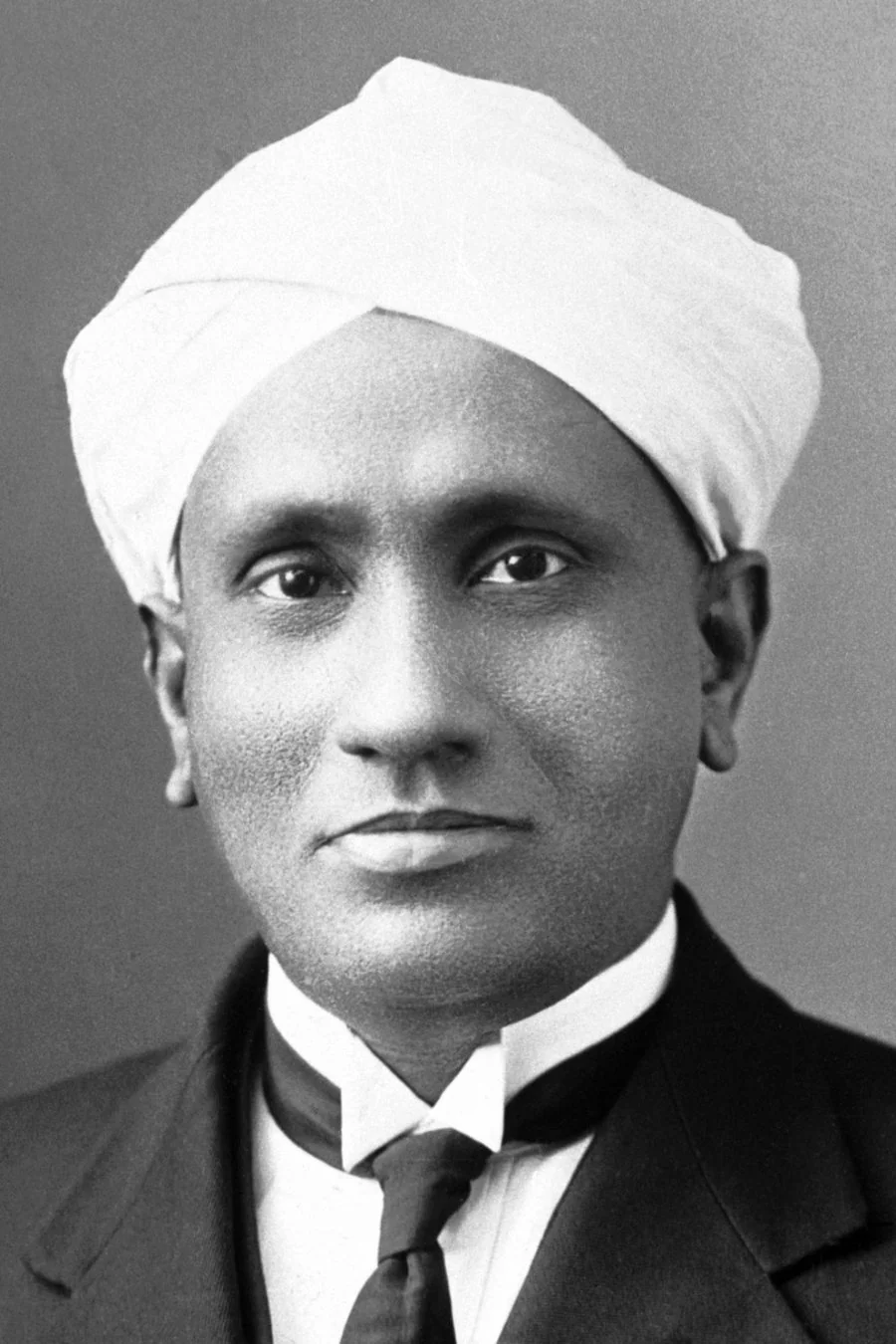
Raman in 1930, the year of the prize. Nobel Foundation. Image record. Public domain.
A fingerprint in the scatter
Shine light of one colour at a substance. Almost all of what scatters back comes out the same colour it went in. A very small share comes back slightly changed. That light has given a little of its energy to a molecule and set the molecule vibrating, or has taken a little from a molecule that was already vibrating.
The size of that change is exact. It equals the energy of one particular vibration in the molecule. Atoms joined by bonds behave like weights on springs. Heavier atoms ring at lower frequencies, and stiffer bonds at higher ones. Each molecule has its own set of notes, and the scattered light carries them.
Raman already knew vibration well. As an accountant he had spent his evenings on the violin’s bowed string. Later he turned to the bridge of the veena and the skin of the tabla.
What struck him most, he told the Nobel audience in December 1930, was how simple the spectra were. A complex molecule that absorbs or emits light gives a dense thicket of lines. The light it scatters carries a few clean ones, easy to read.
For thirty years it stayed a laboratory method, because the signal was so faint. A good photograph could take all night. The laser arrived in 1960. By 1962 a ruby laser had produced a Raman spectrum, and the long exposures began to shrink to seconds.
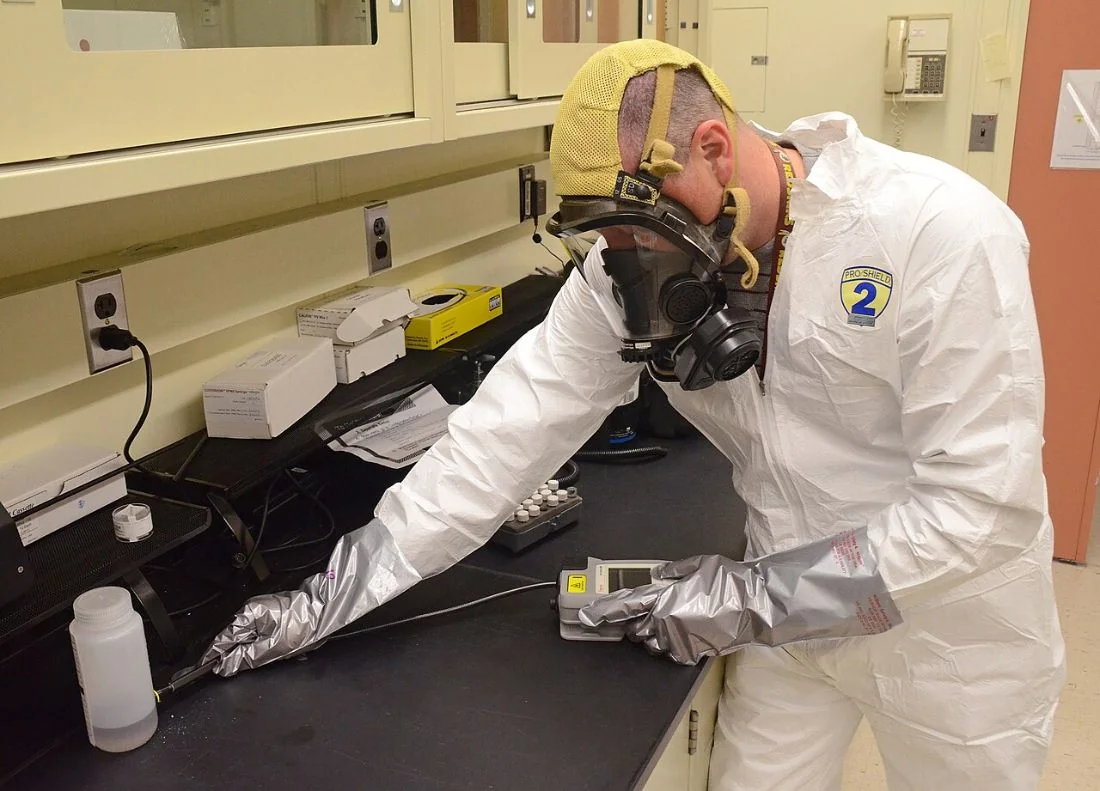
A handheld Raman spectrometer identifying an unknown sample, demonstrated at the US National Institute of Standards and Technology, 2013. NIST. Image record. Public domain.
Today the effect runs inside instruments that never mention Raman’s name.
In the United States, drug manufacturing rules require at least one test to verify the identity of each component that goes into a drug. 21 CFR 211.84(d)(1) A handheld Raman reader can confirm what is in a drum at the loading dock, often through a plastic liner.
On a police bench, Thermo Fisher’s TruNarc handheld checks a street sample against a library. It went on sale in 2012, and the current models carry more than 1,200 substances. Fentanyl and its relatives arrived through a library update.
The instrument measures a fingerprint and looks it up. A substance missing from the library comes back as unknown until the maker adds it.
From Oxfordshire to Santa Clara
At the Rutherford Appleton Laboratory in Oxfordshire, a publicly funded UK facility, Pavel Matousek and colleagues developed spatially offset Raman spectroscopy, a way of collecting the scattered light a few millimetres away from where the laser goes in. It lets a reader see through a plastic bottle or a paper sack to the substance inside.
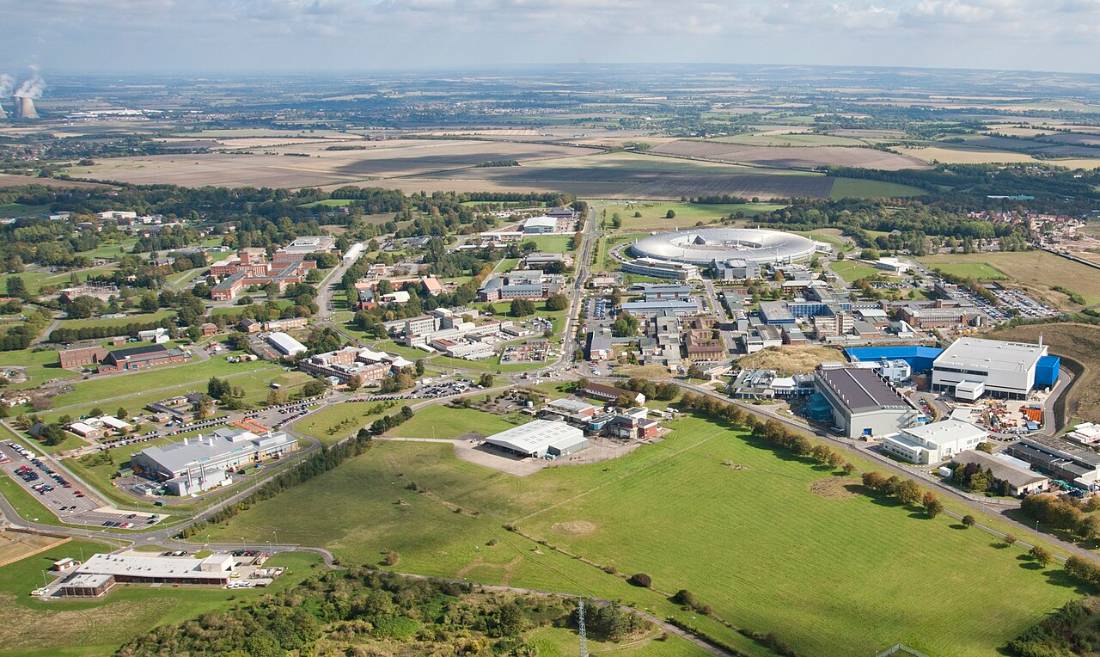
The Rutherford Appleton Laboratory, Oxfordshire. Science and Technology Facilities Council, 2012. Image record. CC BY-SA 2.0.
In 2008 the work was spun out as Cobalt Light Systems. By 2017 Cobalt counted twenty of the twenty-five largest drug companies as customers, and its liquid scanners were screening bottles at more than seventy-five airports in Europe and Asia. That July, Agilent Technologies bought it for about £40 million.
Agilent, based in Santa Clara, California, now sells the instruments and maintains their libraries.
India has a handful of Raman instrument makers. One is TechnoS Instruments in Jaipur. The company says its IndiRAM tester separates natural diamonds from those grown by chemical vapour deposition (CVD) or at high pressure and high temperature (HPHT) in 45 to 90 seconds.
Raman’s diamonds
One of the first two Raman spectra of diamond came out of a wedding ring.
In 1930 C. Ramaswamy, Raman’s younger brother, was a demonstrator at Presidency College in Madras. He wore a diamond wedding ring, a gift from his father-in-law. By the family story, which he told the physicist and biographer G. Venkataraman decades later, Raman urged him to test the stone. Ramaswamy called it the best use he made of his father-in-law’s gift. Journey into Light, p. 514
His letter to Nature, printed on 10 May 1930, describes a diamond of half a carat. Under the mercury lamp it gave a single sharp line, shifted from the lamp line by 1331 to 1333 cm⁻¹. In the same column, two chemists at the Government Laboratory in London reported the same line from their own stone.
Most crystals give several lines. Diamond, one element in a simple, symmetric lattice, gives one.
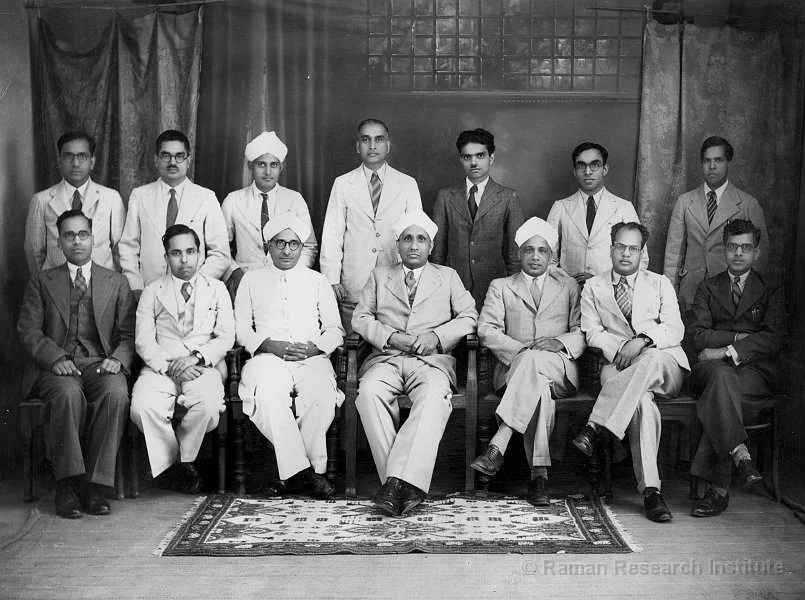
The Calcutta laboratory, around 1929. Seated, from left: A. S. Ganesan, L. A. Ramdas, K. S. Krishnan, C. V. Raman, K. R. Ramanathan, S. Venkateswaran, S. S. Moorthy Rao. Standing, from left: C. Ramaswamy and S. Bhagavantam, with S. Paramasivan, Sreenivasa Rao, N. S. Nagendranath, R. Ananthakrishnan and C. S. Venkateswaran. Raman Research Institute Archives. Image record. Public domain in India.
That year the laboratory borrowed bigger stones. S. Bhagavantam was handed a diamond of about 140 carats, lent by a maharaja against a security bond, for forty-eight hours. He slept two nights under the spectrograph with protective glasses on while the exposure ran. Next to the diamond line he found a blue glow, near 4155 ångströms (415.5 nanometres). Journey into Light, p. 389; Raman 1944, p. 200
Raman moved to Bangalore in 1933. Diamond held him for the rest of his life. At first, he wrote, he had to borrow diamond rings from wealthy friends. Around 1939 he learned that thin cleavage plates of diamond could be bought at modest prices.
In June 1942 the Maharaja of Panna invited him to the state’s diamond fields. Raman set up his instruments in a room of the State Treasury and went through hundreds of stones, the Maharaja’s garland of fifty-two uncut diamonds among them. He bought stones on that visit and again in December.
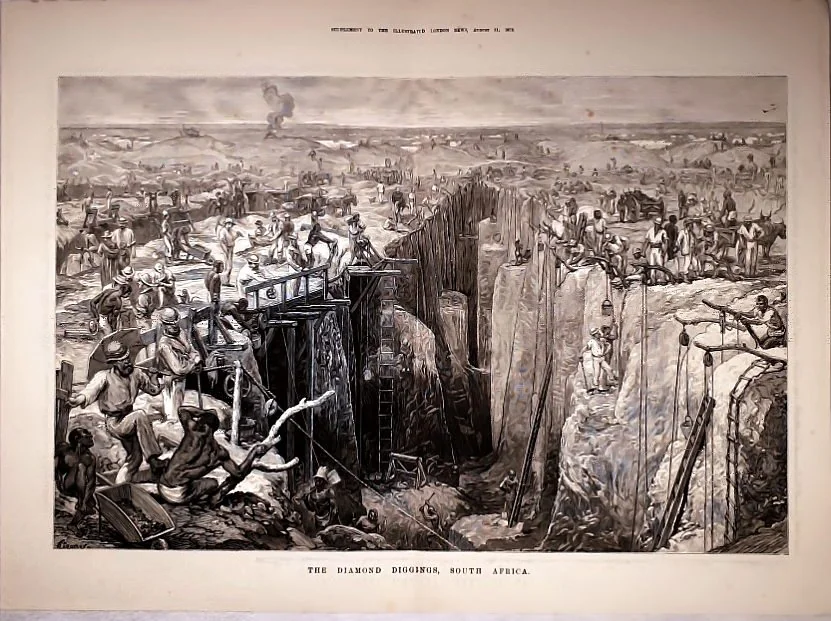
“The diamond diggings of South Africa”, a woodcut after Félix Régamey for the Illustrated London News, 1872. Image record. Public domain.
By 1944, on his own count, he held 310 specimens. Proc. Indian Acad. Sci. A19, pp. 200–202 Twenty-nine were crystals from Panna. Sixty-five were polished cleavage plates, mostly Indian.
Eighty-eight more were South African brilliants, all set in one gold jewel: the double-headed eagle of the state of Mysore. His student Anna Mani photographed it under ultraviolet light. The brightest stone in it glowed a thousand times brighter than the faintest, or more.
Under ultraviolet light
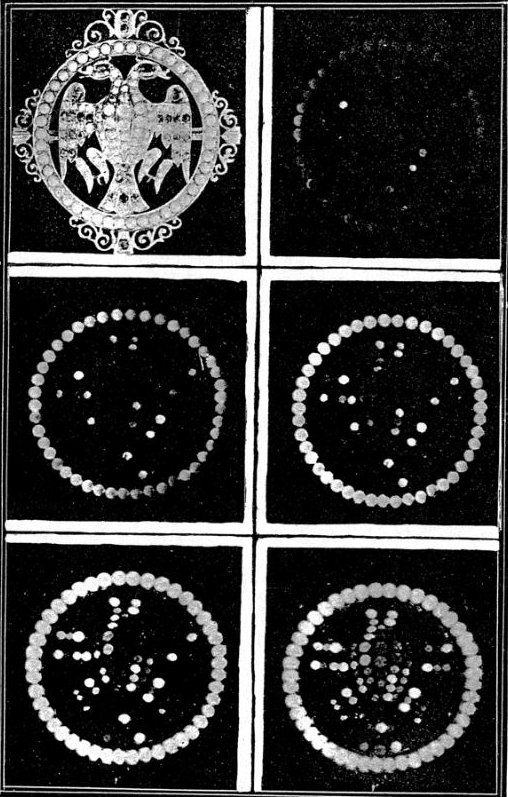
The Mysore eagle. Top left in daylight; the other five panels show the same eighty-eight stones glowing under ultraviolet light at increasing exposures. Plate III.
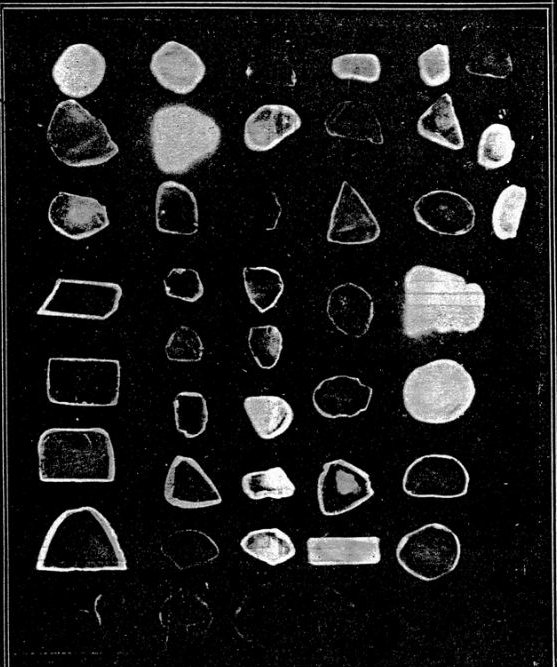
Cleavage plates of diamond under ultraviolet light, glowing from bright to almost nothing. Plate IV.
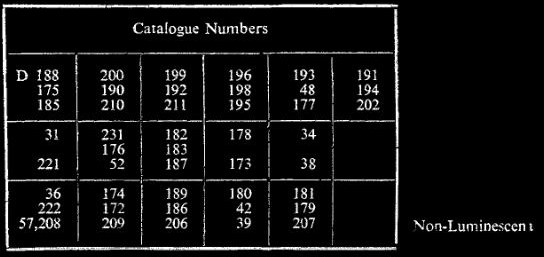
Raman’s own catalogue numbers for the plates above, row by row. The last row did not glow. From Plate IV, inverted for this page. C. V. Raman, “The nature and origin of the luminescence of diamond”, 1944. Source: Indian Academy of Sciences.
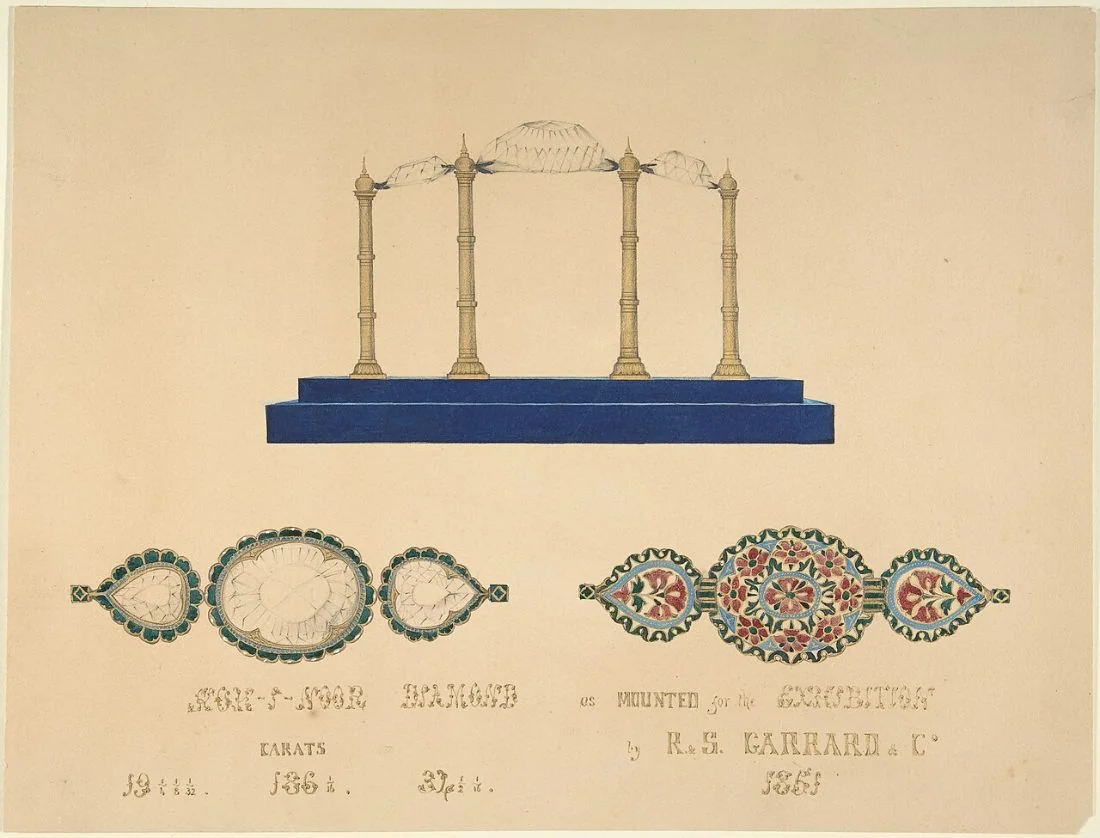
The Koh-i-Noor, drawn by the London jewellers R. S. Garrard & Co., 1851. Metropolitan Museum of Art. Image record. CC0.
Jayaraman put the later collection at about 600 stones, each boxed and named, kept under lock and key. Raman called a tabular stone that glowed blue his Koh-i-Noor. Some stones were gifts. C. V. Raman: A Memoir, p. 78 Most he bought with his own money. Journey into Light, p. 341
In May 1944 the Proceedings of the Indian Academy of Sciences gave an entire issue to diamond. All seventeen papers were by Raman and his students. A19, pp. 189–342 Raman argued that diamond came in four structural forms, and that its glow came from the carbon lattice itself.
The physicist Max Born, who had worked in Bangalore at Raman’s invitation in 1935 and 1936, called Raman’s theory of how crystal lattices vibrate too absurd to take seriously. Later neutron measurements largely sided with Born.
Raman was wrong about the glow too. In 1959 W. Kaiser and W. L. Bond showed that nitrogen marks the difference between the two main types of diamond. The blue glow Bhagavantam saw in 1930 is now called the N3 centre: three nitrogen atoms around a missing carbon, with a sharp line at 415 nanometres.
EXHIBIT CDiamond and graphite are both pure carbon. In diamond’s tetrahedral lattice, carbon’s strongest line sits at 1332 cm⁻¹. Graphite’s flat sheets move it to near 1580 cm⁻¹. Moissanite, a common simulant, sits far away at 767 to 798 cm⁻¹. Positions from Ramaswamy 1930, GIA lab notes and standard references. Drawn by Pharmakon.
In his last years, Bhagavantam recalled, Raman spent a lot of time on the geography and geology of the Krishna valley, where the old Golconda diamonds were mined. Journey into Light, p. 344
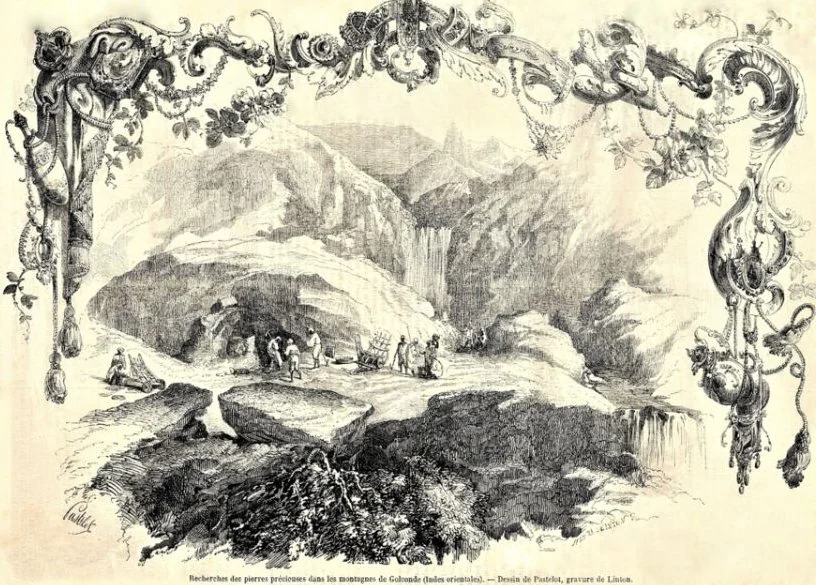
Diamond workings in the Golconda country, engraved for Le Monde illustré, 1875. Image record. Public domain.
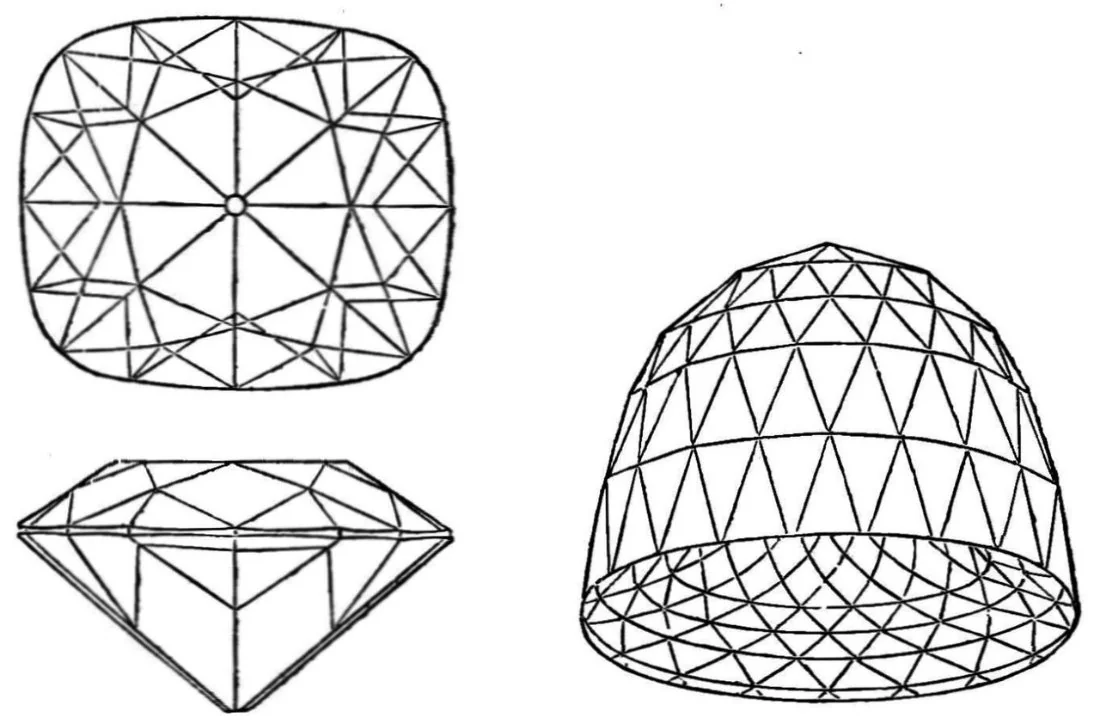
The Star of the South and, right, the Great Mogul, drawn after the sketch Tavernier made of it in India. Popular Science Monthly, 1875–76. Image record. Public domain.
Reading the code
Genome sequencing keeps score with one number: the cost of reading one human genome. In September 2001, by the count of the US National Human Genome Research Institute, it was about $95.3 million. By May 2022 it was $525. The institute stopped updating its series there.
The companies kept going. In 2023 Illumina advertised a $200 genome on its NovaSeq X, at list price on its largest flow cell. In February 2026 Element Biosciences announced a $100 genome. Ultima Genomics had already said it was enabling an $80 one.
EXHIBIT DNHGRI’s cost per genome, September 2001 to May 2022, on a log scale, against the pace of Moore’s law. Hollow points are company list-price claims after the series ends. NHGRI includes labour and equipment costs. The later vendor figures use different cost assumptions and throughput requirements and are not directly comparable measures of total cost. Data: NHGRI; Illumina, Ultima and Element releases. Drawn by Pharmakon.
In 2025, 74% of Illumina’s $4.34 billion in revenue came from consumables, the reagents and flow cells that run on its instruments. A rival, Element, sued in 2025 and called it a razor-blade model. A federal judge dismissed the complaint in May 2026, with leave to amend.
Illumina and the Chinese firm BGI spent years suing each other over sequencing chemistry and detection, until Illumina paid BGI’s Complete Genomics $325 million to settle in 2022.
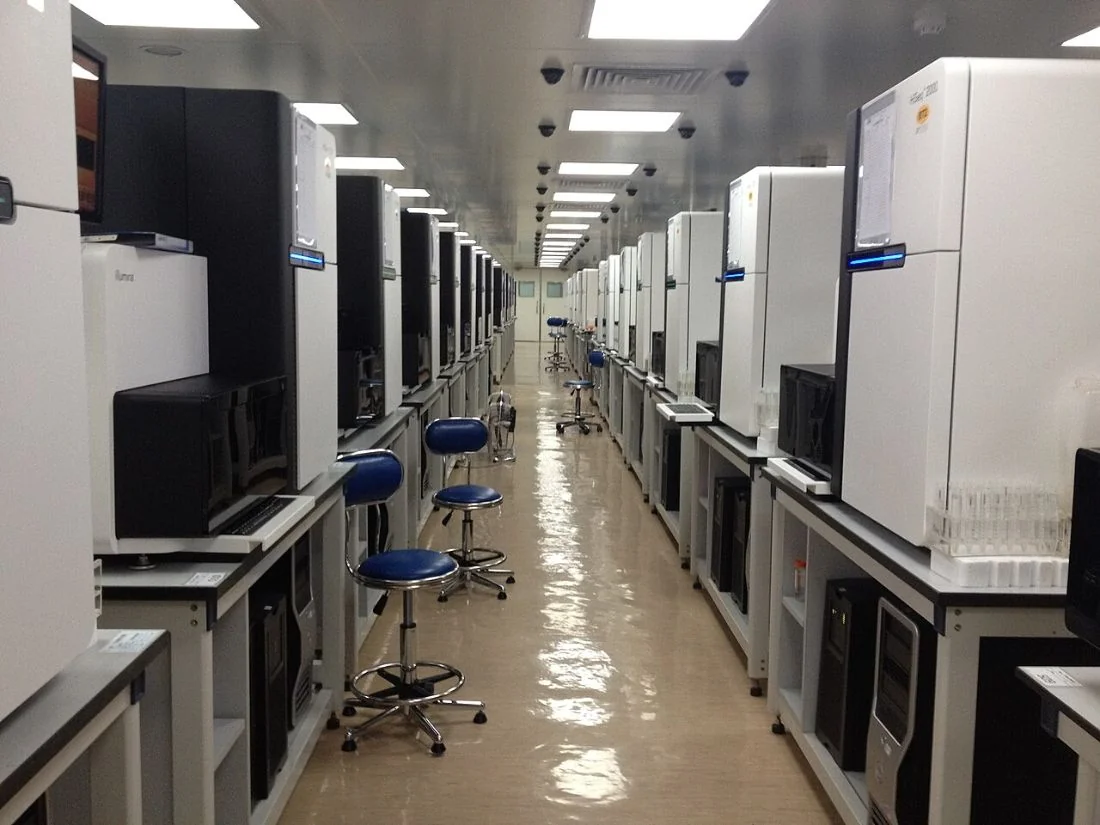
Illumina HiSeq 2000 sequencers on the sequencing floor of BGI in Hong Kong, 2013. Photograph by Scotted400. Image record. CC BY 3.0.
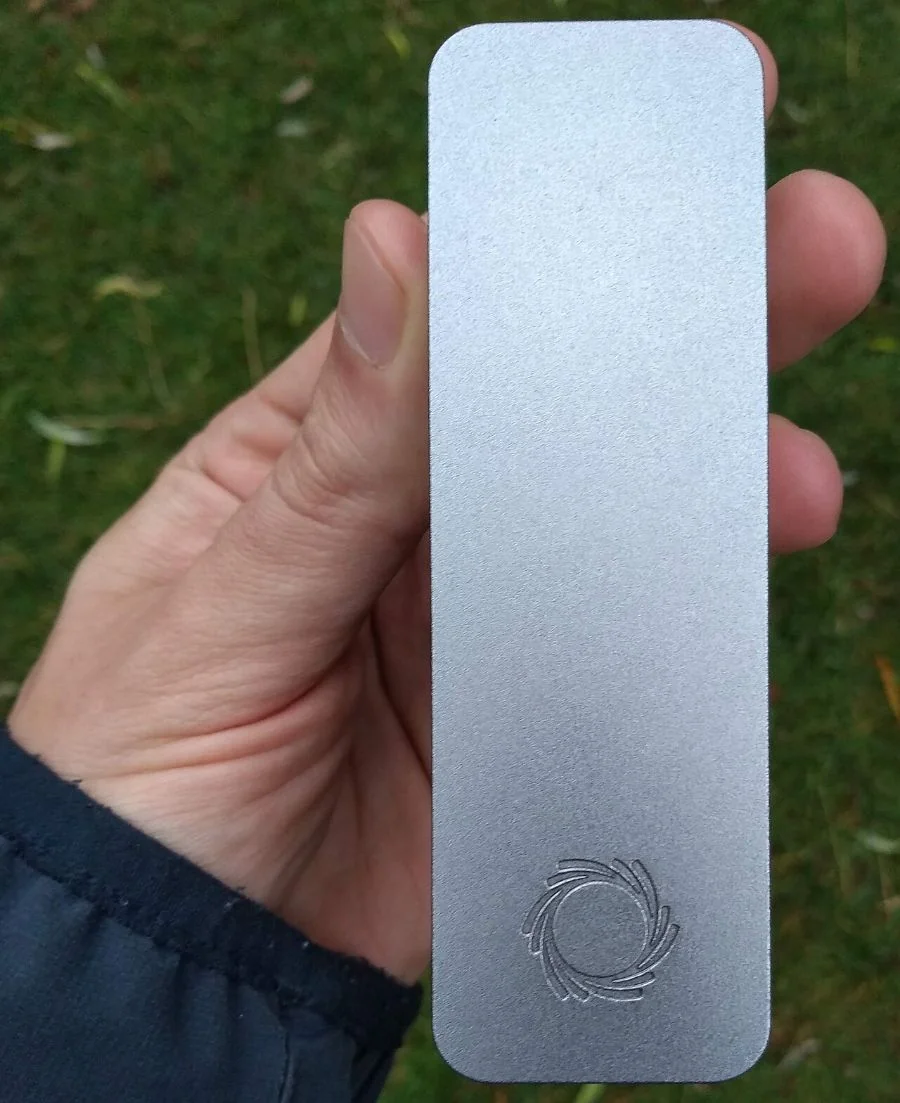
An Oxford Nanopore MinION, a sequencer that runs from a laptop’s USB port. Photograph by Ciro Santilli, 2019. Image record. CC BY-SA 4.0.
On 15 September 2026, the Unified Patent Court’s Munich division granted Oxford Nanopore provisional injunctions against MGI Tech GmbH covering specified nanopore systems. The restrictions differed by patent and together covered eight European jurisdictions.
The patents in play cover how a sensor array is wired to its amplifiers and how a molecule is tied to the membrane before it is read.
In 2013 the US Supreme Court held that a naturally occurring segment of DNA cannot be patented. India’s Patents Act excludes the mere discovery of a scientific principle and of any substance occurring in nature. The patents sit on the instruments and the chemistry that read DNA.
Each base in DNA vibrates in its own pattern, so each has its own Raman fingerprint.
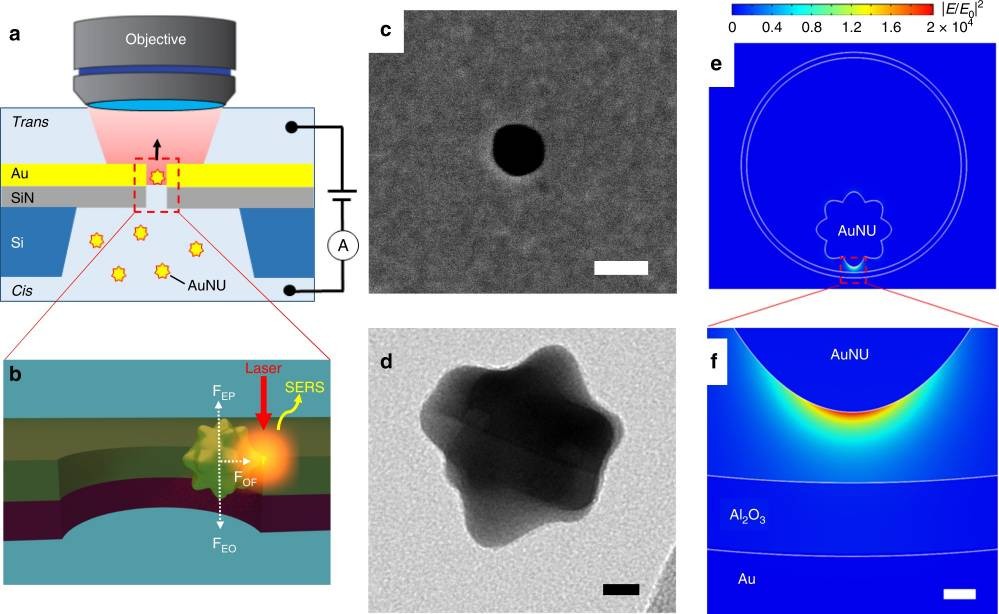
Huang and colleagues, 2019, figure 1. The trap (a, b). The hole in the gold film (c, scale bar 200 nm). The gold nanourchin (d, 10 nm). A simulation of the light at the tip of one spike, concentrated up to 20,000 times (e, f; 2 nm). Nature Communications 10, 5321. Paper. CC BY 4.0.
In 2019 J.-A. Huang and colleagues in Francesco De Angelis’s group at the Istituto Italiano di Tecnologia in Genoa held a single gold nanoparticle inside a plasmonic nanohole for minutes at a time.
The particle is a gold nanourchin, spiked like the animal. An applied voltage and the laser together hold it in a hole in a thin gold film. The light piles up in the gap between one spike and the wall of the hole. A molecule on the spike, sitting in that gap, scatters enough light to be read on its own.
They coated the particles with short strands of DNA ten letters long: nine cytosines and one adenine. At some moments the scattered light carried the lines of both bases. At others it carried the lines of adenine alone, at 623 and 883 cm⁻¹. The trap had picked one base out of a strand of ten by its light.
In 2020 the group did the same for amino acids inside peptides.
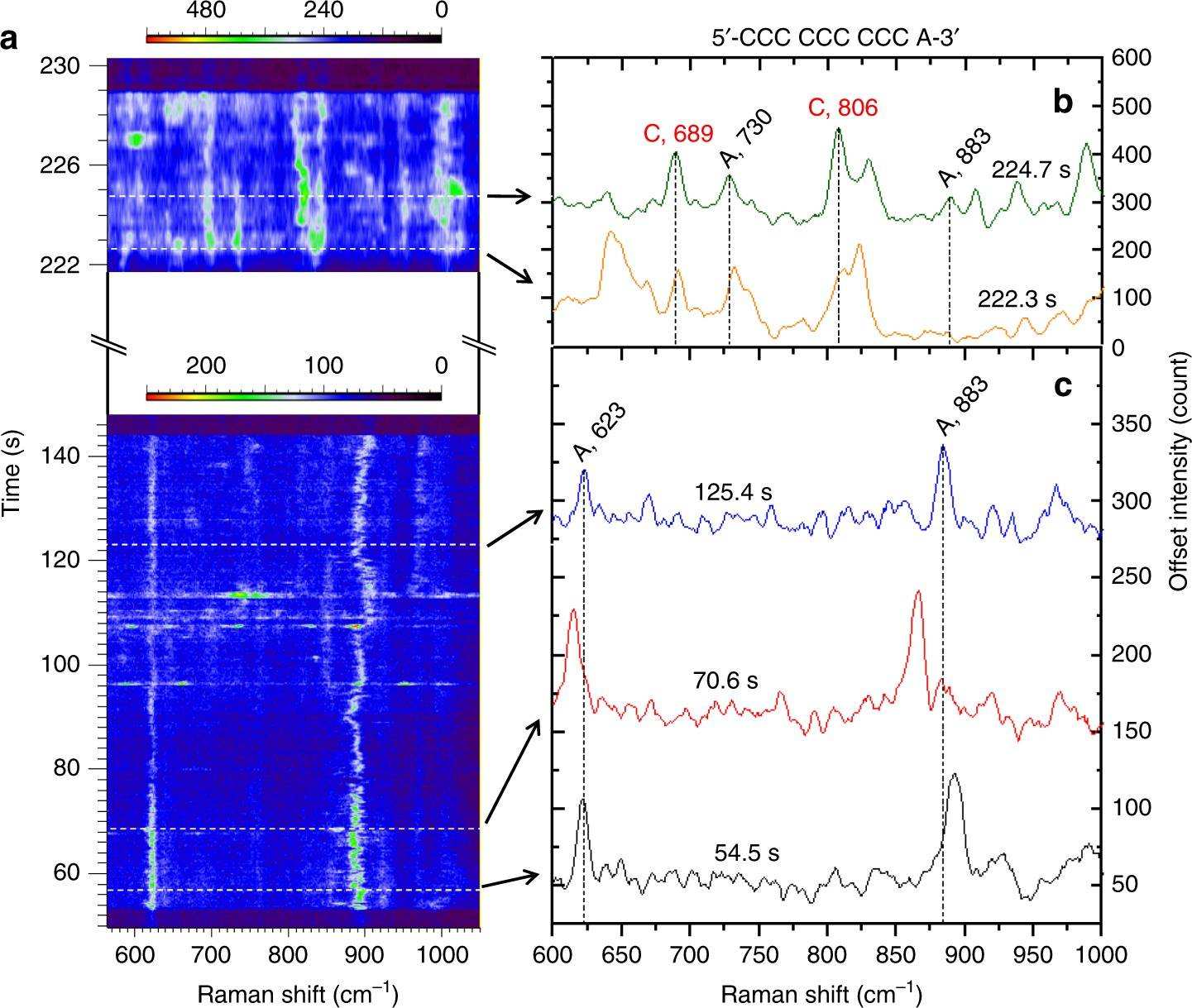
Huang and colleagues, 2019, figure 5. One strand, 5′-CCC CCC CCC A-3′, read in the trap. Left, the scattered light over time, one row per spectrum, about 1,400 in all. Right, single moments. At 224.7 seconds the spectrum shows lines of both C and A (b). At 54.5, 70.6 and 125.4 seconds it shows adenine alone (c). Nature Communications 10, 5321. Paper. CC BY 4.0.
In March 2026 the Genoa group and the Politecnico di Milano passed peptides one at a time through gaps under 2 nanometres wide and read them with a single-photon camera. Vasopressin and oxytocin are hormones that differ by two amino acids. In this proof-of-concept experiment, a trained classifier distinguished the two peptides with 70.5% accuracy for individual translocation events. Averaging forty events raised accuracy to 99%.
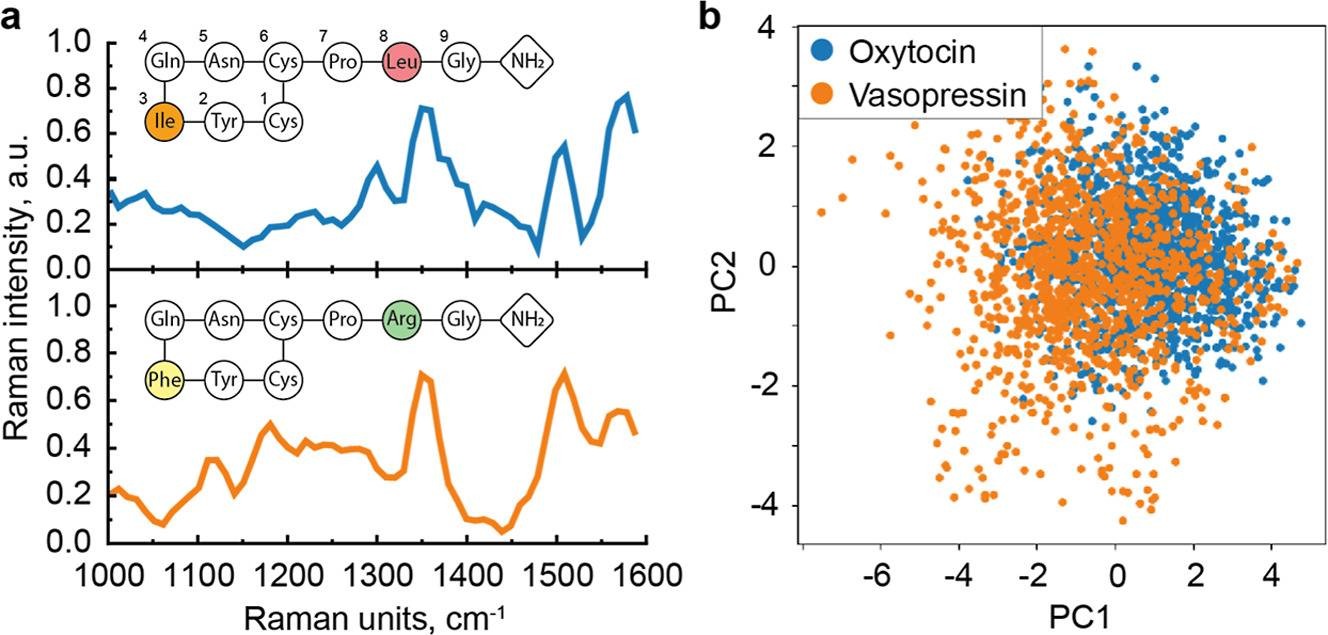
Khabarov and colleagues, 2026, figure 2. Left, the average spectrum of oxytocin (top) and vasopressin (bottom), each with its nine amino acids drawn above it. The two positions where they differ are coloured. Right, every dot is one molecule, read as it passed through a gap. The two clouds overlap, so a single read is often unsure. ACS Photonics 13, 1840. Paper. CC BY 4.0.
None of this reads a whole genome yet.
A Raman-based reader for DNA would still need an instrument and a library of reference spectra. Both could be built in the open, in the country where the effect was found.
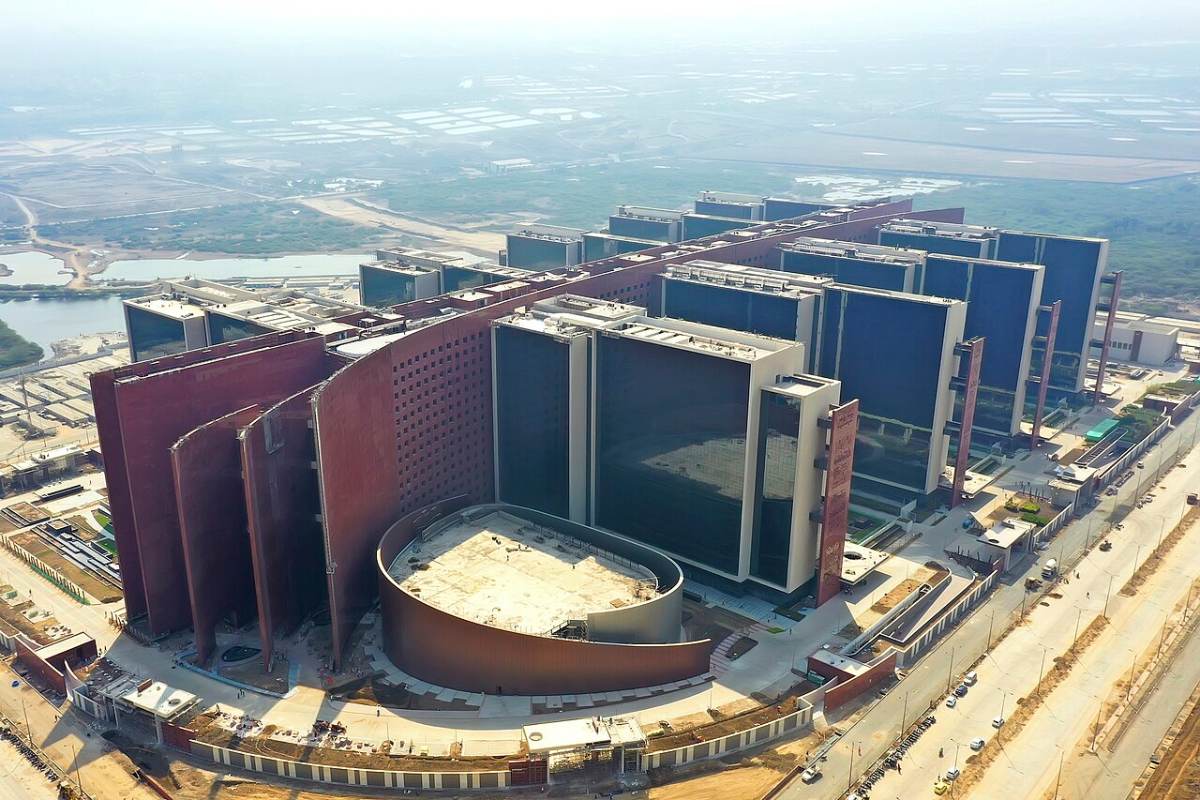
The Surat Diamond Bourse, photographed in 2021. VaishP. Image record. CC BY-SA 4.0.
Surat
In 1930 a diamond of about 140 carats had to be borrowed from a maharaja for two nights.
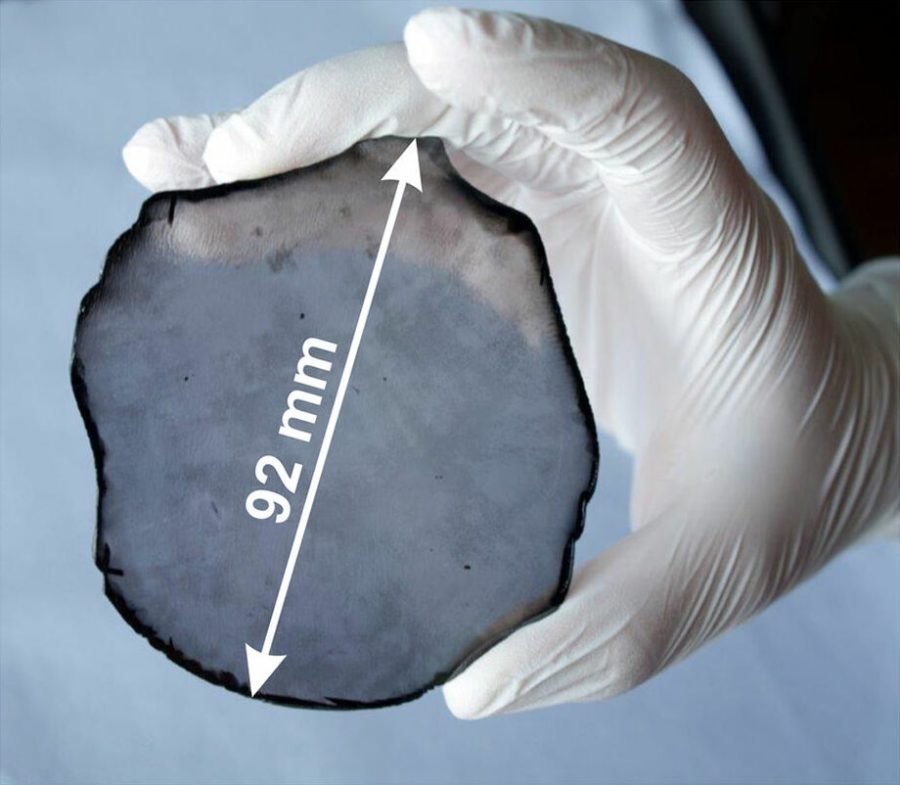
A single crystal of diamond, 155 carats, grown by chemical vapour deposition. Schreck, Gsell, Brescia and Fischer, Scientific Reports 7, 44462 (2017), figure 5. Paper, CC BY 4.0.
In 2017 physicists at the University of Augsburg, led by Matthias Schreck, published a photograph of a single diamond crystal about 90 millimetres across, grown on iridium over a zirconia layer on a silicon wafer. It weighed 155 carats.
Surat is where India cuts and polishes most of its diamonds, and India cuts most of the world’s. India’s 2023 budget speech put the country’s share at about three quarters of global turnover by value. Reuters in 2025 put it at nine stones in ten.
Now Surat grows them too. A CVD reactor is a vacuum chamber in which a plasma lays carbon atoms down, layer by layer, on a thin seed plate of diamond. By June 2026 India had an estimated 14,000 or more, about double the count three years earlier. Each costs ₹75 to 80 lakh and grows about 125 carats a month.
The Union government helped. In February 2023 the Union budget cut the customs duty on seeds for lab-grown diamonds from 5% to nil, and IIT Madras was granted ₹242 crore over five years for a national centre on lab-grown diamond. In February 2026 duty-free seed imports were extended to March 2028.
More carats, less money
In March 2026 lab-grown stones made up 51% of India’s loose polished diamond exports by volume. By value, lab-grown stones are under 9% of India’s diamond exports.
The average exported carat of polished lab-grown diamond was worth $246 in 2016–17. In 2025–26 it was worth $60.
EXHIBIT EFiscal years run April to March. Export values from the Gem and Jewellery Export Promotion Council; the 2024–25 lab-grown value and the per-carat figures from the Times of India, 20 June 2026, which prints the 2024–25 value as $1.267 million where billion is meant. Drawn by Pharmakon.
De Beers launched its own lab-grown brand, Lightbox, in 2018 at $800 a carat. In May 2025 the company said wholesale prices of lab-grown diamonds for jewellery had fallen 90% since then. It announced it would close Lightbox.
Natural diamonds fell too. India’s exports of cut and polished natural diamonds dropped from $22.05 billion in 2022–23 to $12.16 billion in 2025–26. American tariffs in 2025 cut demand further. In December 2025 the diamond workers’ union told Al Jazeera that about 50,000 workers had left the city in just over a year.
The screen
A grown diamond and a mined one are the same carbon in the same lattice, and both give the Raman line at 1332 cm⁻¹. They differ in trace impurities, above all nitrogen.
Most natural diamonds contain aggregated nitrogen and are classified as type Ia. Type II diamonds have no nitrogen detectable by infrared spectroscopy. Near-colourless lab-grown diamonds are usually type II, as are about 1 to 2% of natural diamonds.
The first screen tests for nitrogen.
De Beers built DiamondSure in the early 1990s to run that test. The machine looks for one absorption line at 415 nanometres, the N3 centre. In the instrument’s published trial it appeared in over 95% of natural diamonds tested and in none of the synthetics. It is the blue glow Bhagavantam photographed in a borrowed stone in 1930.
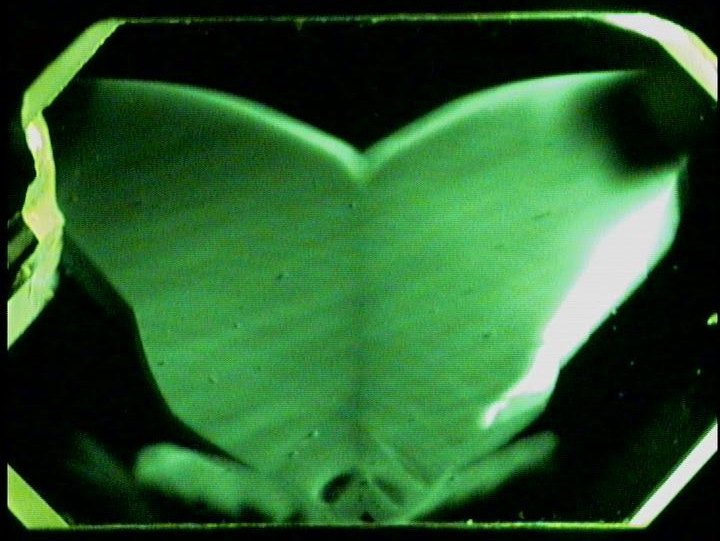
A synthetic diamond glowing under an ultraviolet laser. The pattern records how the crystal grew. Image width about 2 mm. Materialscientist, NIMS. Image record. CC BY-SA 3.0.
A stone that shows the line passes, and the rest are referred to a laboratory.
There the diamond is cooled in liquid nitrogen to minus 196 °C, which sharpens its spectral lines, and lit with lasers of several colours. CVD stones often show a silicon doublet near 737 nanometres. The Gemological Institute of America (GIA) measures peaks such as the silicon doublet against the diamond’s own Raman line at 1332 cm⁻¹, the line Ramaswamy measured in 1930.
Small stones go through machines. De Beers’ AMS2 sorts melee, the tiny stones set in pavé, at up to 3,600 an hour, and decides diamond or simulant by looking for the Raman peak. In 2018 it cost $45,000. Surat builds its own testers. DRC Techno launched one in 2016. Decent Technology lists a tabletop CVD tester at ₹4.11 lakh.
The growers adapt. GIA reports that the average silicon signature in CVD stones submitted to it fell a hundredfold over ten years, and that about 80% of the CVD stones submitted to it since 2020 had been treated after growth.
Researchers in Japan grew colourless CVD layers onto natural type Ia diamonds. GIA reports that these hybrids passed the standard UV, N3 and infrared screens. Deep-ultraviolet imaging and photoluminescence caught them.
The certificate
A grading certificate sets what a stone sells for, and issuing certificates is a business.
In 2023 Blackstone bought the International Gemological Institute (IGI). Fosun, the majority seller, disclosed a total price of $569.65 million. On 20 December 2024 IGI’s Indian arm listed on the NSE and BSE after a ₹4,225 crore offer. Its prospectus put IGI’s share of lab-grown diamond certification at about 65%.
GIA, a non-profit, has narrowed its reports on grown stones. From 1 October 2025 its D-to-Z laboratory-grown diamond service replaced the colour and clarity grades used for mined stones with an overall assessment. A grown diamond that qualifies now gets one of two words, Premium or Standard, and the words Laboratory-Grown inscribed on its girdle.
The word diamond is contested too. In 2018 the US Federal Trade Commission removed “natural” from its definition of a diamond. India’s new standard, IS 19469:2025, reserves the bare word for mined stones. It calls for the rest to be described as laboratory-grown or laboratory-created diamond, in full. In September 2026 the jewellery confederation CIBJO voted to recommend the word synthetic.
De Beers itself was put up for sale by Anglo American in May 2024. On 17 July 2026, Botswana’s minister told parliament that Anglo had selected the Global Diamond Consortium as its preferred bidder. He did not name its partners. Anglo said the sale process was continuing. On 7 October, Anglo’s chief executive said he hoped to complete the sale by the end of the year.
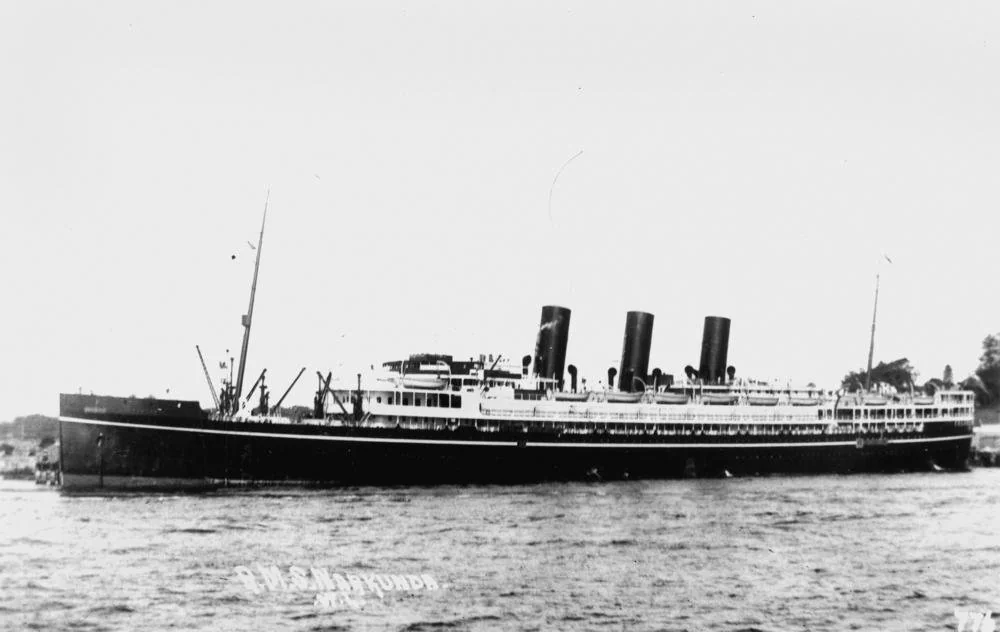
SS Narkunda. She was sunk in November 1942. John Oxley Library, State Library of Queensland. Image record. Public domain.
Back at the rail
On the Narkunda, Raman’s prism told him the blue came from inside the water. Looking cost him nothing, and nobody could have stopped him. The effect he found seven years later is a law of nature, and anyone may use it.
Today a quality officer with a drum of powder at a factory gate needs the answer. So does a trader in Surat with a parcel of stones that look identical.
Each of them sees a result on a screen: pass or refer, natural or laboratory-grown. That result comes from an instrument and a reference library that a company built and sells.
Raman did his first ten years of research before dawn and after dark, in a borrowed laboratory on Bowbazar Street, because the government owned his days.
The claims, checked
| Claim | Where it lives | What the record shows |
|---|---|---|
| Raman discovered the effect alone | Nobel citation, 1930 | Partly. Krishnan signed the first letter. Landsberg and Mandelstam recorded it in Moscow a week before Raman saw the lines in benzene. |
| The 140-carat stone came from Darbhanga | Later retellings | Unconfirmed. Bhagavantam names only a wealthy maharaja. Raman gives the weight as 143 carats and names no lender. |
| Raman spent his Nobel money on diamonds | Popular accounts | Disputed. Pisharoty says the prize money went toward his institute. Venkataraman reports Raman later wishing he had spent it on radium instead of diamonds. |
| Diamond’s blue glow comes from carbon itself | Raman, 1944 | Rejected. Nitrogen, linked to the diamond types by Kaiser and Bond in 1959. The glow is the N3 centre. |
| Every lab-grown diamond can be told from a natural one | De Beers, 2024 | Demonstrated for these samples. Research hybrids passed the standard UV, N3 and infrared screens. Deep-ultraviolet imaging and photoluminescence caught them. This does not guarantee detection of every future material. |
| Illumina produces over 90% of the world’s sequencing data | Illumina website | Company claim. Footnoted to Illumina’s own 2015 calculation. No independent figure found. |
| The $100 genome | Element, 2026 | List price. A company figure. The NHGRI series ends at $525 in May 2022. |
| A naturally occurring DNA sequence can be patented | Common assumption | No. US Supreme Court, 2013. India’s Patents Act, section 3(c), excludes substances occurring in nature. Instruments and methods can be patented. |
Timeline
| Date | Event |
|---|---|
| 1876 | Mahendralal Sircar founds the Indian Association for the Cultivation of Science in Calcutta. |
| Jun 1907 | Raman joins the Finance Department in Calcutta and starts working at the Association before and after office hours. |
| Oct 1907 | His first Nature letter, signed from the “Science Association Laboratory”. |
| Jul 1917 | Raman leaves government service for the Palit Chair of Physics. |
| Sep 1921 | On the SS Narkunda, Raman tests Rayleigh’s account of the blue sea with a Nicol prism. |
| 1922 | Molecular Diffraction of Light is published in Calcutta. |
| Apr 1923 | K. R. Ramanathan sees a faint glow in purified water that will not go away. |
| 16 Feb 1928 | Raman and Krishnan send “A New Type of Secondary Radiation” to Nature. |
| 21 Feb 1928 | Landsberg and Mandelstam record new lines in quartz in Moscow. |
| 28 Feb 1928 | Raman and Krishnan examine the modified scattering with a spectroscope. |
| May 1930 | C. Ramaswamy publishes the Raman line of diamond. |
| Dec 1930 | Nobel Prize in Physics, to Raman alone. |
| 1933 | Raman moves to the Indian Institute of Science, Bangalore. |
| Jun 1942 | Raman examines the Panna stones in the State Treasury. |
| May 1944 | The Indian Academy of Sciences gives an issue to diamond: seventeen papers. |
| 1958 | Raman receives the 1957 Lenin Peace Prize in Moscow. |
| 1959 | Kaiser and Bond link the main types of diamond to nitrogen. |
| 1960 | The first laser. |
| 1962 | A ruby laser records a Raman spectrum. |
| Nov 1970 | Raman dies in Bangalore. |
| 1996 | De Beers publishes its DiamondSure and DiamondView verification methods. |
| Sep 2001 | Sequencing one human genome costs about $95.3 million. |
| 2008 | Cobalt Light Systems is spun out of the UK Science and Technology Facilities Council. |
| 2012 | Thermo Fisher’s TruNarc handheld drug analyser is introduced. |
| Jun 2013 | The US Supreme Court rules that naturally occurring DNA cannot be patented. |
| 2017 | Agilent buys Cobalt for about £40 million. Augsburg physicists publish a 155-carat CVD diamond crystal. |
| 2018 | De Beers launches Lightbox at $800 a carat. The FTC drops “natural” from its definition of a diamond. |
| Nov 2019 | The Istituto Italiano di Tecnologia group in Genoa tells single DNA bases apart by their scattered light. |
| May 2022 | Sequencing one human genome costs $525, the last point in the NHGRI series. |
| Jul 2022 | Illumina pays Complete Genomics $325 million to settle their patent dispute. |
| Feb 2023 | India’s budget removes duty on lab-grown diamond seeds and funds a centre at IIT Madras. |
| May 2023 | Blackstone agrees to buy IGI. |
| Dec 2024 | IGI’s Indian arm lists on the NSE and BSE. |
| May 2025 | De Beers announces it will close Lightbox. |
| Oct 2025 | GIA’s Premium and Standard assessments for D-to-Z lab-grown diamonds take effect. |
| Mar 2026 | Lab-grown stones reach 51% of India’s loose polished diamond exports by volume. Peptides are read one molecule at a time with light in Genoa and Milan. |
| Sep 2026 | The Unified Patent Court’s Munich division grants provisional injunctions covering specified MGI Tech GmbH nanopore systems. CIBJO recommends the word synthetic. |