
Honoré de Balzac wrote his novels at night, on coffee. He described taking it ground and dry, on an empty stomach.
He described the result himself, in an 1839 essay on modern stimulants. The ideas came up like battalions on a battlefield. Memories charged in with flags flying.
Balzac had a workplace stimulant. His account tells us what it felt like to write on coffee, not whether coffee made him clever.
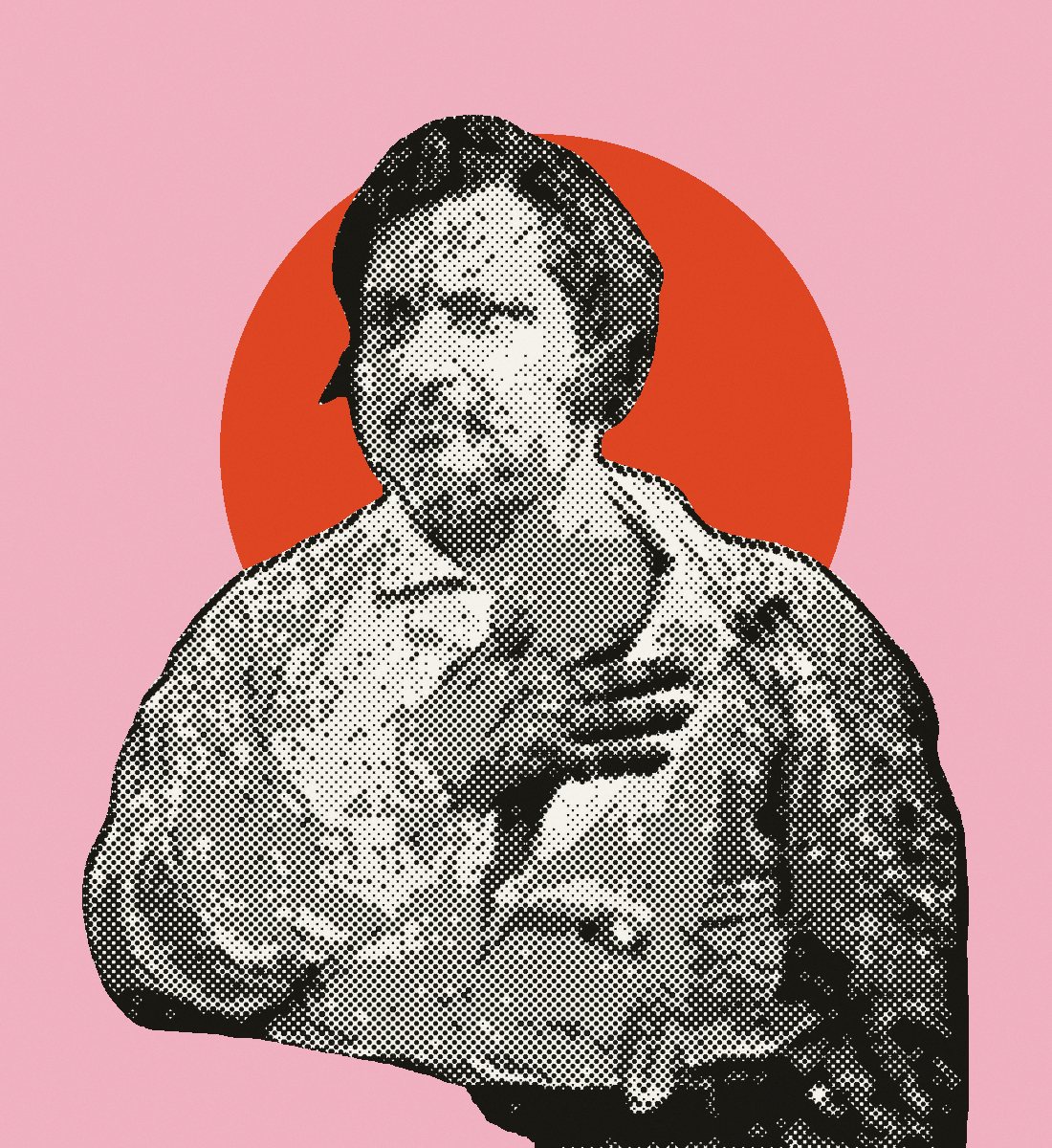
A century later a Belgian drug company would sell the clever part. The word it used was nootropic, a term now used to sell "brain supplements" online.
For a study published online in 2020, Pieter Cohen and colleagues tested ten supplements bought in September 2019. They selected products whose labels named particular unapproved drugs, not a random sample of the market. All ten contained omberacetam, sold in Russia as Noopept but not FDA-approved. The highest amount per serving was about four times the usual single dose cited by the researchers. Nine of twelve declared quantities were inaccurate.
Those bottles brought together chemically different drugs under one sales pitch. The racetams are one family within that trade, not a name for everything it sells.
Where did the word come from?
In 1964 chemists at UCB, outside Brussels, made a ring-shaped cousin of GABA, the brain's main braking chemical. The file number was 6215. The usual account says it was meant as a sedative. In animals it sedated almost nothing. It had almost no side effects. In some tests the animals learned faster.
The pharmacologist on the project, Corneliu Giurgea, spent the next eight years deciding what that meant. In 1972 he published his answer in a French journal. The compound was the first of a new class. He called the class nootrope, from the Greek for mind and for turning. He set out criteria: better learning, protection against brain insults, almost no toxicity, none of the sedation or stimulation of other psychiatric drugs.
The molecule was piracetam. The word was the product.
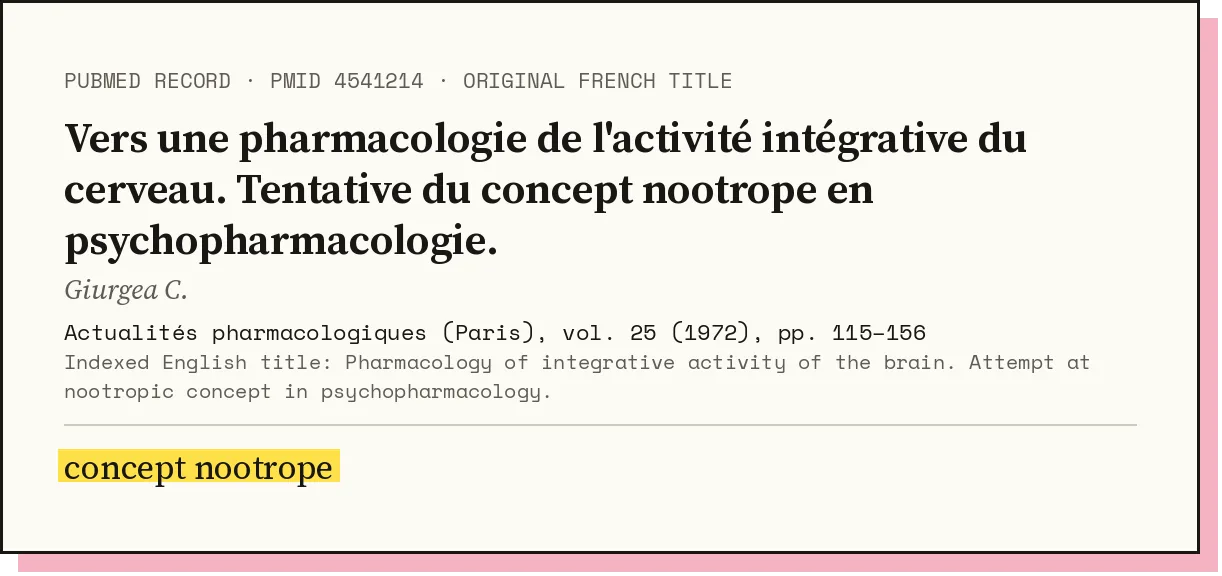
In Britain, piracetam is a prescription medicine licensed for cortical myoclonus, a movement disorder. That is a different indication from improving memory. It has never been approved by the FDA for anything, and the agency's position is that it cannot be sold in the United States as a dietary supplement.
The ring stayed. Over the next forty years companies in Belgium, Japan, the Soviet Union and elsewhere hung new side chains on it and tried again.
piracetam
UK · myoclonus
no FDA approval
aniracetam
Japan · post-stroke
recalled 2000
nefiracetam
Daiichi · Japan
studied for dementia
fasoracetam
Vascular dementia
programme discontinued
coluracetam
Mitsubishi · cognition
efficacy endpoints missed
phenylpiracetam
USSR · Russia
marketed in Russia
levetiracetam
UCB · epilepsy
FDA 1999
brivaracetam
UCB · epilepsy
FDA 2016
What did Japan find?
Japan prescribed drugs for these problems under a blunter name. The Japanese category was
脳循環代謝改善剤nō junkan taisha kaizen-zai: drugs that improve cerebral circulation and metabolism.
Through the 1980s and 1990s Japanese doctors prescribed them after strokes, mostly for apathy and memory trouble. Idebenone alone went to an estimated eight million patients between 1986 and 1998.
Then the health ministry ran a re-evaluation. In May 1998 it withdrew four drugs after new placebo-controlled trials failed to establish efficacy: idebenone, propentofylline, indeloxazine and bifemelane. These were not racetams; they belonged to the wider Japanese prescribing category. That August five Japanese authors wrote to The Lancet questioning the approvals.
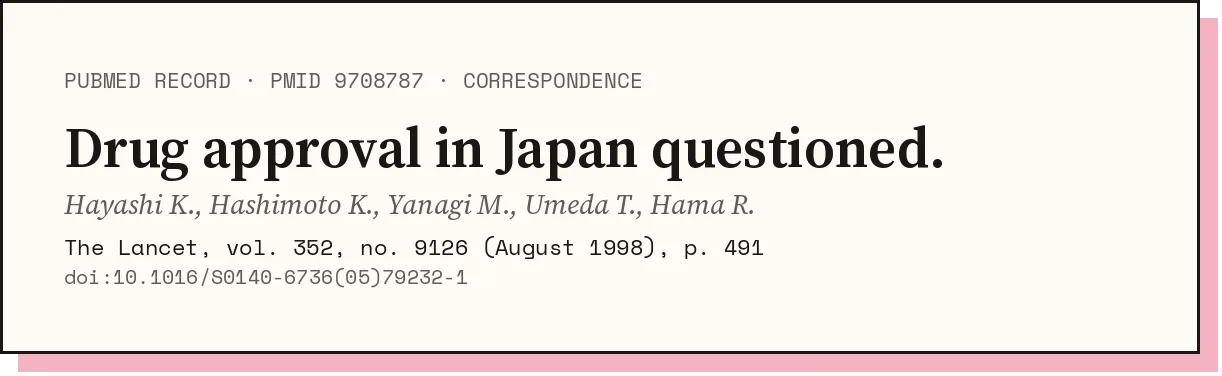
The letter criticised subjective global-improvement ratings without structured criteria. Trials tested 30–100 endpoints without accounting for multiple comparisons, and excluded so many patients that most endpoints were assessed in only half those eligible. The authors argued that the reported benefits did not reproduce consistently.
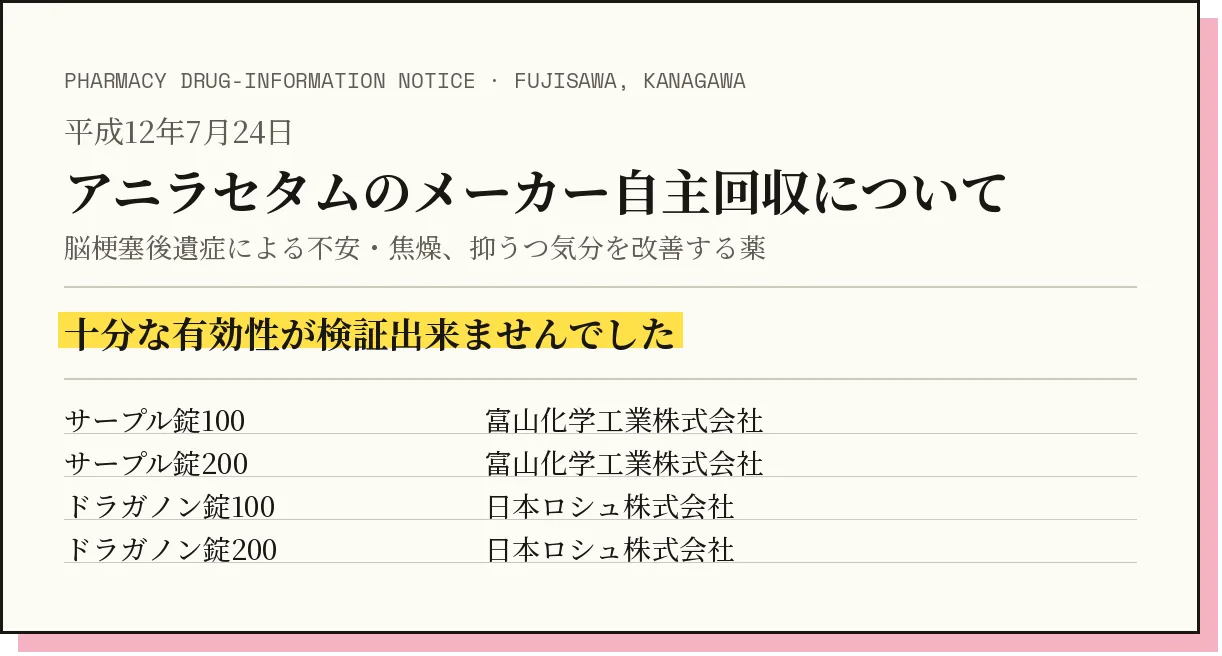
The racetams were on the same shelf. Aniracetam was Roche chemistry, sold in Japan as Draganon by Nippon Roche and as Sarpul by Toyama Chemical. Its label covered anxiety, agitation and low mood after a stroke. It got its own post-marketing trial against placebo. A pharmacy notice dated 24 July 2000 reported that both manufacturers were recalling their products voluntarily. The trial had not shown sufficient efficacy; the notice said no new safety problem had prompted the recall.
Other Japanese racetams reached clinical trials without establishing treatments for those indications. Daiichi's nefiracetam was studied for dementia and post-stroke apathy. Nippon Shinyaku took fasoracetam into Phase 3 for vascular dementia, then discontinued that programme. That was not the end of research on the molecule: a small ADHD study published in 2018 examined a different indication. It was exploratory, not proof of routine clinical benefit.
What about the one that worked on choline?
One Japanese branch did something new. Mitsubishi's MKC-231, later named coluracetam, has the racetam ring and a large fused ring system on the other end. Its target was high-affinity choline uptake, the slowest step in making acetylcholine, the messenger that memory research had focused on since the 1970s.
In rats whose cholinergic neurons had been chemically damaged, the drug improved performance on a memory task. A three-paper series from Mitsubishi in 2008 found something odder. After repeated dosing, the improvement was still measurable 24 hours after the last dose, when the drug was no longer detectable in the brain. The researchers proposed that more choline transporters had moved to the neurons' surface.
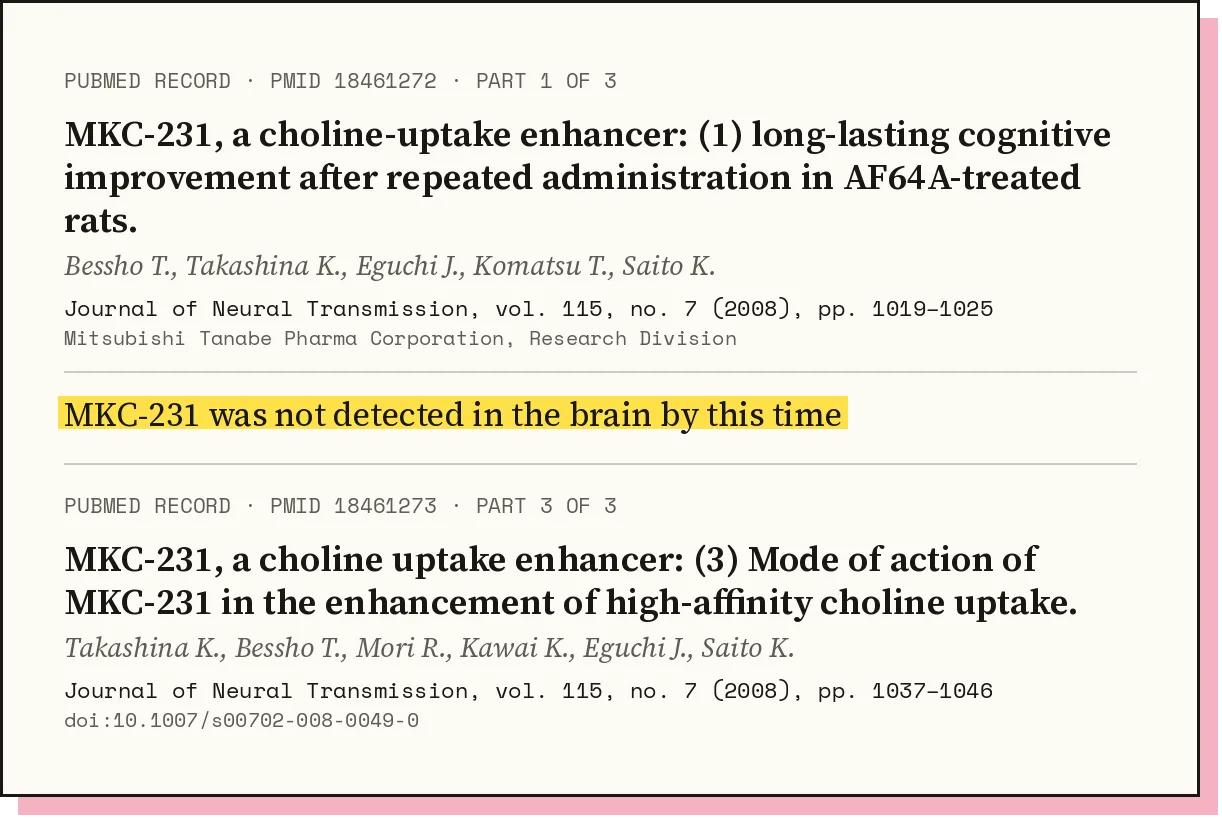
On 10 August 2006 a San Diego start-up, BrainCells Inc., announced it had licensed the compound. Its release said Mitsubishi had suspended the program because the drug met safety expectations and did not reach its efficacy endpoints. BrainCells renamed it BCI-540 and pursued it for depression with anxiety. The licensing announcement did not establish a benefit in patients. Coluracetam later appeared for sale online.
Does piracetam touch anything real?
It does. It is a weak effect at a real receptor.
In 1990 a team in Japan showed that aniracetam boosts currents through what are now called AMPA receptors, which carry much of the brain's fast excitatory signalling. Twenty years later Ahmed and Oswald at Cornell got crystal structures of piracetam sitting on the same receptor, at a site no drug had been seen using before. Their paper title says piracetam "defines a new binding site." It binds weakly. The structures are in the Protein Data Bank.
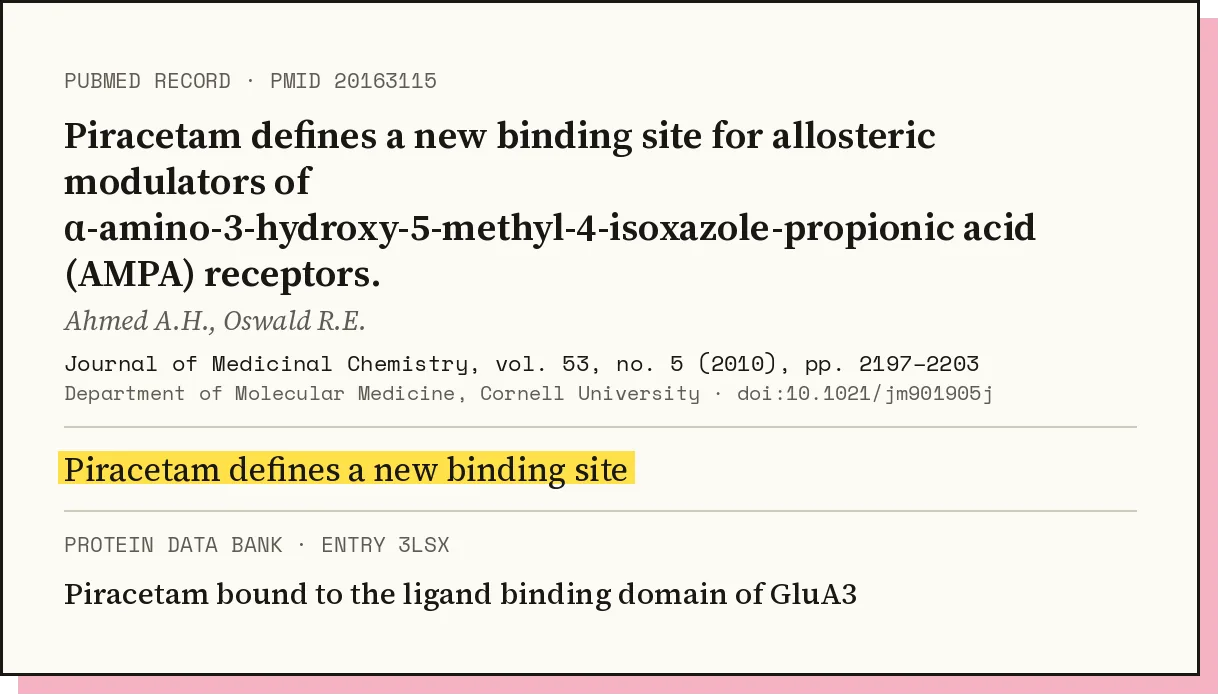
A binding site is a long way from a better memory. A 1976 double-blind study in healthy volunteers did report improved verbal learning after fourteen days. That finding deserves to be in the record. It does not, by itself, establish a reliable benefit across people and everyday tasks, and the receptor structures cannot settle that question.
What did Moscow do with it?
The Soviet branch hung a phenyl ring on piracetam's backbone. The result is phenylpiracetam, also listed as fonturacetam and, in sport, as carphedon. It is sold in Russia as a prescription drug. It is on the World Anti-Doping Agency's list of banned stimulants.
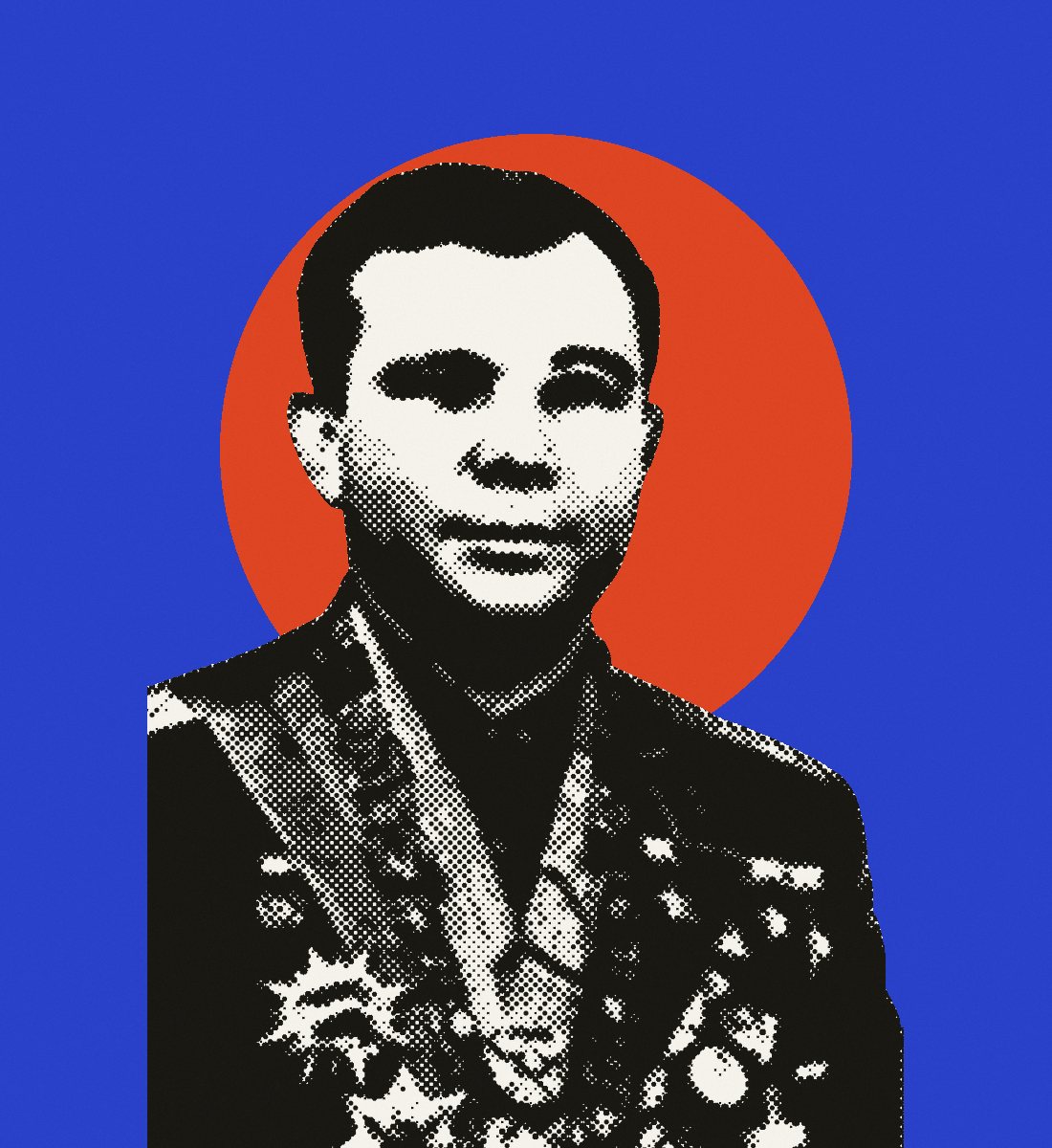
The story sellers tell is that it was developed for cosmonauts. That story lives in vendor copy. Pharmakon has not found a primary document that puts it on a flight.
The Russian pharmacy shelf also carries drugs sold for cognition that are not racetams. Omberacetam is a dipeptide derivative, sold as Noopept. It was the drug found in every product in Cohen's sample, and it has no FDA approval.
How did the epilepsy drugs emerge?
UCB never stopped working on the ring. In 1966 its chemists made etiracetam, an ethyl cousin of piracetam. In 1977 they separated its two mirror-image forms. The active one was later named levetiracetam.
Through the 1980s UCB tested it in patients with cognitive impairment. Those trials did not establish it as a treatment.
In 1992 a UCB pharmacologist, Alma Gower, published its anticonvulsant profile. The drug powerfully protected mice bred to convulse at loud noises, and her paper called its pattern of activity unique. In 1993 Wolfgang Löscher's group in Hanover showed that it blocked kindled seizures, a model used to study focal epilepsy. But it was inactive in two conventional screening tests: maximal electroshock and seizures induced by a subcutaneous dose of pentylenetetrazol. UCB's 1998 study confirmed that unusual profile. Relying on those two tests alone would have missed its potential.
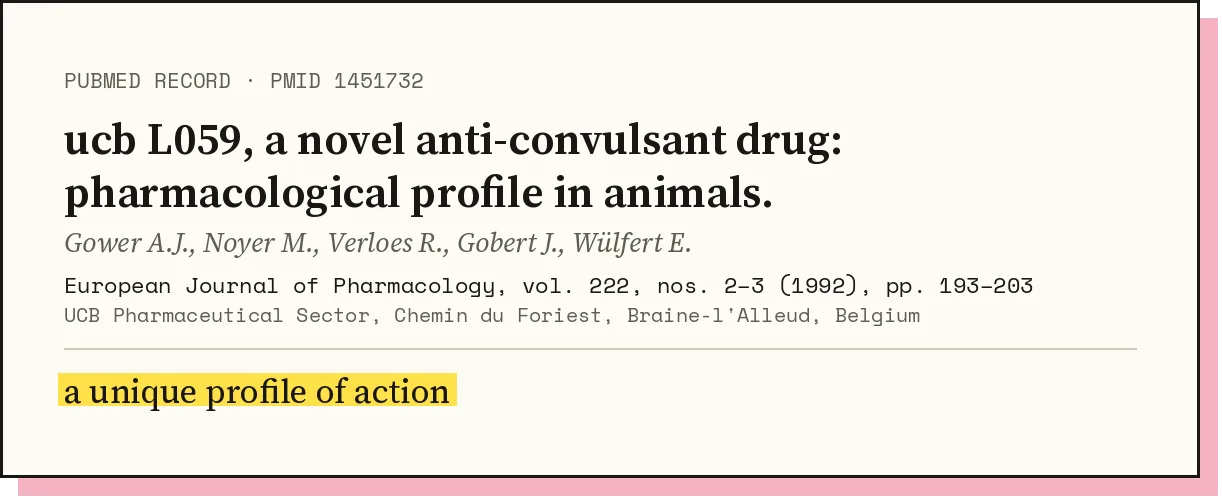
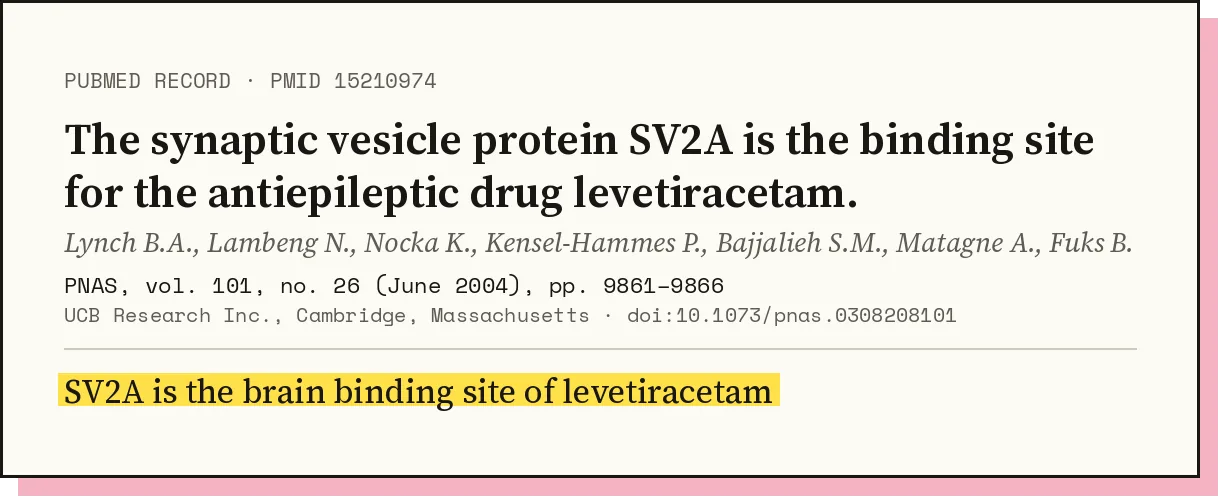
The FDA approved levetiracetam for epilepsy in 1999. Its molecular binding target had not yet been identified. UCB had found a specific binding site in brain tissue in 1995. In 2004 a UCB team identified the protein: SV2A, which sits on the small sacs neurons use to release their messengers. The drug had been on the market for five years.
UCB was already designing compounds to bind that site more tightly. Its January 2004 discovery paper described the candidate that became brivaracetam, before the SV2A identification paper appeared. Brivaracetam binds SV2A more tightly than levetiracetam. The FDA approved it in 2016.
A compound developed for memory became an epilepsy medicine.
So what is in the bottle?
In 2001 the Cochrane Collaboration reviewed the piracetam trials in dementia and cognitive impairment. Most were old and badly reported. Doctors' global impressions sometimes improved. Specific measures of memory and thinking mostly did not. The reviewers concluded the evidence did not support clinical use.
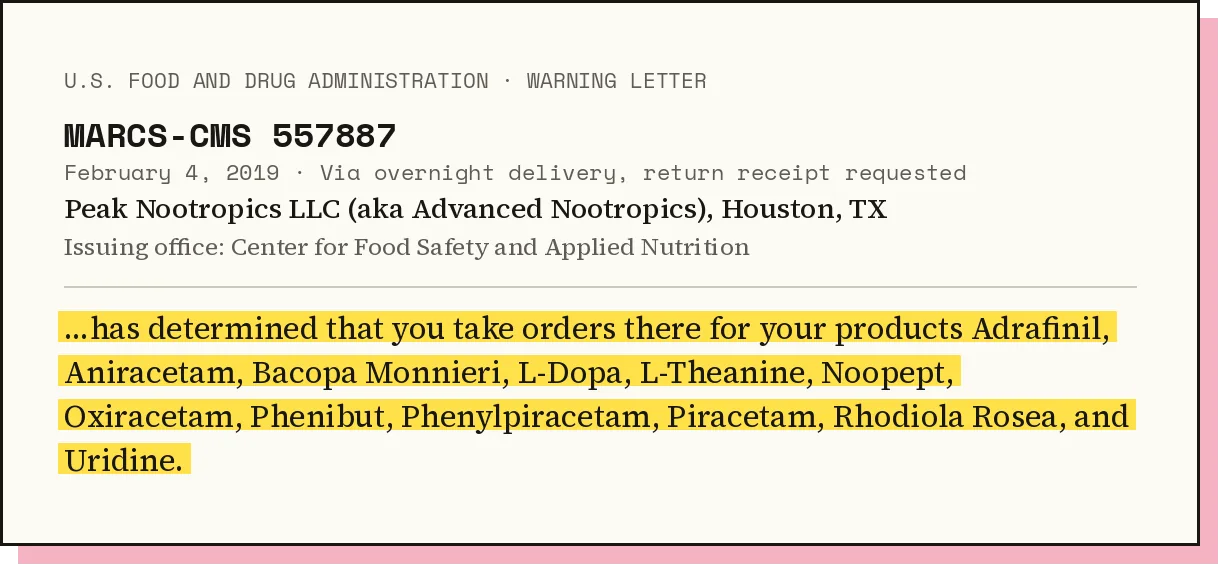
In February 2019 the FDA and the Federal Trade Commission sent warning letters to online sellers of racetams. That November, Pieter Cohen's group reported piracetam on sale in American supplements anyway, labeled as such. The 2020 study followed.
single doses cited in the study most found in one serving
The claims, checked
| Claim | Where it lives | What the record shows |
|---|---|---|
| Piracetam improves memory in healthy people | Supplement labels | Early positive finding A 1976 study reported better verbal learning; that does not establish general cognitive enhancement. |
| Piracetam helps in dementia | Trials from the 1970s to 1990s | Not supported Cochrane 2001 |
| Aniracetam treats emotional disturbance after stroke | Japanese label, 1990s | Withdrawn July 2000, failed placebo trial |
| Coluracetam raises choline uptake | Mitsubishi rat studies | Shown in rats Separately, BrainCells reported that Mitsubishi's human programme missed efficacy endpoints. |
| Piracetam binds a real receptor | Crystal structures, 2010 | Confirmed Weak binding at AMPA receptors |
| Phenylpiracetam was made for cosmonauts | Vendor copy | No primary document found |
| Levetiracetam stops seizures | FDA approval, 1999 | Confirmed |
| Declared quantities were accurate in the tested products | Ten selected supplements | Often inaccurate 9 of 12 quantities; not a market-wide estimate. |
Timeline
| 1839 | Balzac publishes his essay on modern stimulants. |
| 1964 | UCB synthesizes compound 6215, piracetam. |
| 1966 | UCB makes etiracetam. |
| 1972 | Giurgea coins nootrope. |
| 1976 | A double-blind study reports improved verbal learning with piracetam in healthy volunteers. |
| 1977 | Etiracetam's enantiomers are separated. The S form becomes levetiracetam. |
| 1980s | Levetiracetam fails as a treatment for cognitive impairment. |
| 1986 | Idebenone goes on sale in Japan. |
| 1990 | Aniracetam shown to potentiate AMPA-type receptor currents. |
| 1992 | Gower reports levetiracetam's anticonvulsant profile. |
| 1995 | A specific levetiracetam binding site is reported in brain tissue. |
| May 1998 | Japan withdraws idebenone, propentofylline, indeloxazine and bifemelane. |
| Aug 1998 | Hayashi and colleagues question the approvals in The Lancet. |
| 1999 | FDA approves levetiracetam for epilepsy. |
| Jul 2000 | Aniracetam recalled in Japan after failing its post-marketing trial. |
| 2001 | Cochrane review finds the piracetam evidence does not support clinical use for dementia or cognitive impairment. |
| 2004 | January: UCB publishes the brivaracetam discovery work. Later that year, SV2A is identified as levetiracetam's binding target. |
| Aug 2006 | BrainCells licenses MKC-231 after Mitsubishi's program misses its endpoints. |
| 2010 | Piracetam crystallized on the AMPA receptor. |
| 2016 | FDA approves brivaracetam. |
| 2018 | An exploratory fasoracetam study in adolescents with ADHD is published. |
| Feb 2019 | FDA and FTC warning letters to racetam sellers. |
| 2020 | Results published online for ten supplements bought in September 2019. All ten contained omberacetam. |
Pharmakon
A publication, not a treatment. Nothing here recommends any drug or supplement for any person. Highlights on the documents are ours.
Sources and documents
- Balzac H. de. Traité des excitants modernes, 1839.
- Giurgea C. Vers une pharmacologie de l'activité intégrative du cerveau: tentative du concept nootrope en psychopharmacologie. Actual Pharmacol 1972;25:115–156 (PMID 4541214).
- Hayashi K, Hashimoto K, Yanagi M, Umeda T, Hama R. Drug approval in Japan questioned. Lancet 1998;352(9126):491. doi:10.1016/S0140-6736(05)79232-1 (PMID 9708787).
- アニラセタムのメーカー自主回収について (On the manufacturers' voluntary recall of aniracetam). Kamaya Pharmacy drug-information notice, Fujisawa, 24 July 2000.
- Bessho T, et al. (part 1); Takashina K, et al. (parts 2 and 3). MKC-231, a choline uptake enhancer. J Neural Transm 2008. Part 1, doi:10.1007/s00702-008-0053-4; part 2, doi:10.1007/s00702-008-0048-1; part 3, doi:10.1007/s00702-008-0049-0.
- BrainCells Inc. In-licenses clinical-stage CNS compound from Mitsubishi Pharma Corporation. Company press release, 10 August 2006.
- Ito I, Tanabe S, Kohda A, Sugiyama H. Allosteric potentiation of quisqualate receptors by a nootropic drug aniracetam. J Physiol 1990;424:533–543. doi:10.1113/jphysiol.1990.sp018081 (PMID 1975272).
- Ahmed AH, Oswald RE. Piracetam defines a new binding site for allosteric modulators of AMPA receptors. J Med Chem 2010;53(5):2197–2203. doi:10.1021/jm901905j (PMID 20163115). PDB 3LSX.
- Gower AJ, Noyer M, Verloes R, Gobert J, Wülfert E. ucb L059, a novel anti-convulsant drug: pharmacological profile in animals. Eur J Pharmacol 1992;222:193–203 (PMID 1451732).
- Löscher W, Hönack D. Profile of ucb L059, a novel anticonvulsant drug, in models of partial and generalized epilepsy in mice and rats. Eur J Pharmacol 1993;232:147–158.
- Klitgaard H, Matagne A, Gobert J, Wülfert E. Evidence for a unique profile of levetiracetam in rodent models of seizures and epilepsy. Eur J Pharmacol 1998;353:191–206.
- Noyer M, et al. The novel antiepileptic drug levetiracetam (ucb L059) appears to act via a specific binding site in CNS membranes. Eur J Pharmacol 1995;286:137–146.
- Lynch BA, et al. The synaptic vesicle protein SV2A is the binding site for the antiepileptic drug levetiracetam. PNAS 2004;101(26):9861–9866. doi:10.1073/pnas.0308208101 (PMID 15210974).
- Rogawski MA. Brivaracetam: a rational drug discovery success story. Br J Pharmacol 2008;154:1555–1557.
- Flicker L, Grimley Evans J. Piracetam for dementia or cognitive impairment. Cochrane Database Syst Rev 2001;(2):CD001011. doi:10.1002/14651858.CD001011 (PMID 11405971).
- US FDA and FTC. Warning letters to Peak Nootropics LLC (aka Advanced Nootropics), dated 4 February 2019 in the letter body, MARCS-CMS 557887; and Pure Nootropics LLC, 5 February 2019, MARCS-CMS 565425.
- Cohen PA, Zakharevich I, Gerona R. Presence of piracetam in cognitive enhancement dietary supplements. JAMA Intern Med 2020;180(3):458–459. Published online November 2019.
- Cohen PA, Avula B, Wang YH, Zakharevich I, Khan I. Five unapproved drugs found in cognitive enhancement supplements. Neurol Clin Pract 2021;11(3):e303–e307. Published online 2020. doi:10.1212/CPJ.0000000000000960.
- Idebenone in Japan, 1986–1998, estimated eight million patients: IPPoMS trial protocol, ClinicalTrials.gov NCT00950248, background section.
- Dimond SJ, Brouwers EM. Increase in the power of human memory in normal man through the use of drugs. Psychopharmacology 1976;49:307–309. doi:10.1007/BF00426834.
- Elia J, et al. Fasoracetam in adolescents with ADHD and glutamatergic gene network variants disrupting mGluR neurotransmitter signaling. Nat Commun 2018;9:4. doi:10.1038/s41467-017-02244-2.
- Physicochemical and structural analysis of N-phenylacetyl-L-prolylglycine ethyl ester (Noopept), 2024 (PMID 39298839). Used here to identify the compound, not to establish clinical efficacy.
- Kenda BM, et al. Discovery of 4-substituted pyrrolidone butanamides as new agents with significant antiepileptic activity. J Med Chem 2004;47:530–549. doi:10.1021/jm030913e.
- Nootropil 1200 mg film-coated tablets: Summary of Product Characteristics. UK prescribing information, updated July 2025.
Images
- Cover illustration: adapted by Pharmakon from the Soviet SVEMA matchbox label, c. 1960s–70s, maker unknown (MatchboxPosters collection scan, via Wikimedia Commons; listed as public domain). The red background was extended using AI-assisted image editing; this cover is an adaptation, not an unaltered archival scan.
- Honoré de Balzac, daguerreotype by Louis-Auguste Bisson, 1842. Public domain, via Wikimedia Commons.
- Yuri Gagarin, by Valentin Cheredintsev, 1967. NASA on The Commons, via Wikimedia Commons; no known copyright restrictions. Photo illustration by Pharmakon.
- Exhibit B: structures drawn by Pharmakon with RDKit from published formulas.
- Exhibits A and C to I: records transcribed and set by Pharmakon from PubMed, the FDA letter and the pharmacy notice listed above. Highlights ours.
- Exhibit J: chart drawn by Pharmakon from Cohen et al. 2020.
Could not verify
The date on which Daiichi withdrew its Japanese application for nefiracetam, and any primary record tying phenylpiracetam to the Soviet space program. If you hold either, write to us.