
Sometime in the late 2000s, on a Russian dairy farm, a veterinarian walked up to a pregnant cow with two things in his hands.
The first was a syringe holding a cocktail he called the "Bioinformation Elixir." He injected a few drops of it just under the skin, at acupuncture points along the animal's body.
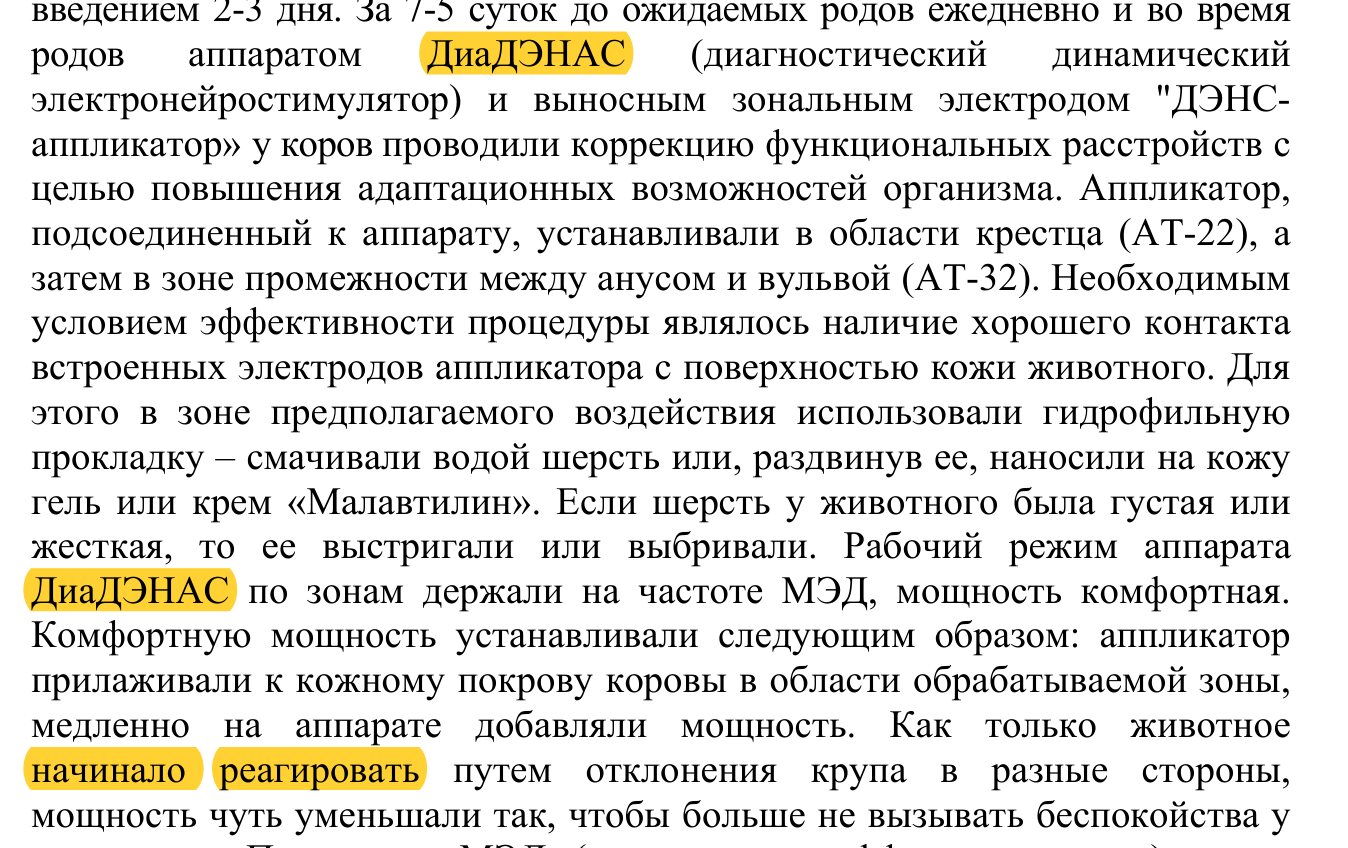
The second was a small electronic box with a flat electrode on the end. He pressed it against the cow's sacrum, then against the skin between her tail and her vulva, and switched it on. When the cow started shifting her hindquarters away, he turned the power down a notch, just enough that she stopped fidgeting.
Then he waited for her to give birth, and timed it.
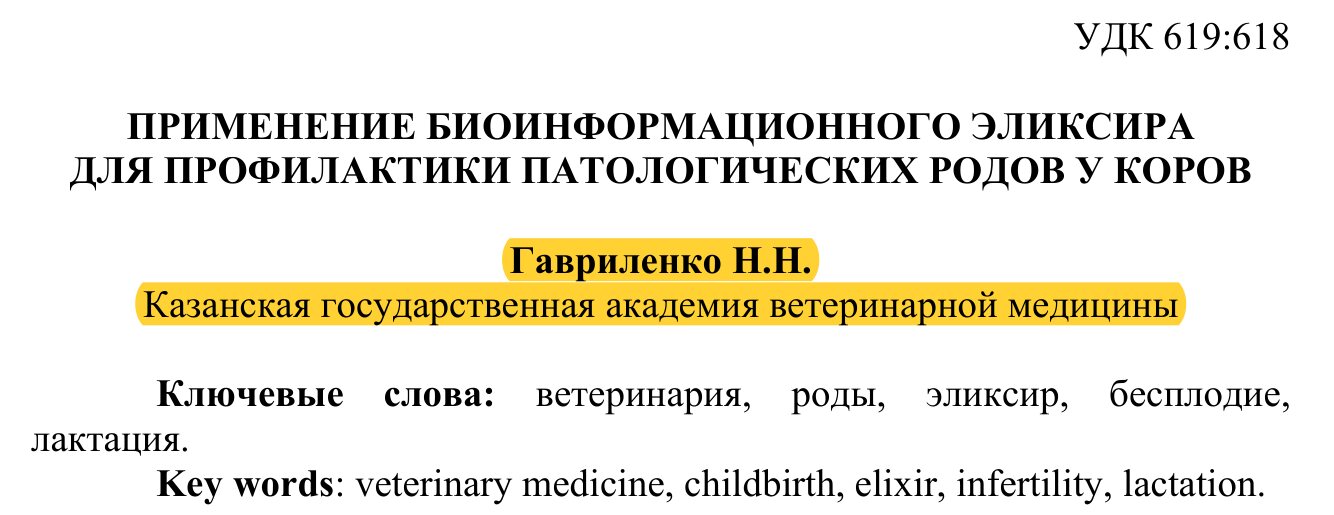
This is a real study. It was published in 2010 in the journal of the Kazan State Academy of Veterinary Medicine, and it became part of a doctoral dissertation in veterinary science defended in 2011. It involved twenty cows. Pull on its threads and you end up in a Cold War radio-engineering institute, a Leningrad military medical lab, a 1947 frog-distillation experiment, and a fight between Soviet inventors that is still running on their company websites.
It's a small story. It explains a big one: how Russia came to have a whole ecosystem of "biomodulators," "bioregulators," and "bioinformation" therapies, and why it's so hard to tell what, if anything, in it works.
What was in the syringe?
According to the dissertation, the Bioinformation Elixir contained four things.
- Thymalin. A polypeptide extract of calf thymus, from the line of work led by the Soviet physicians Vladimir Morozov and Vladimir Khavinson. It is the founding product of what Russian medicine calls "peptide bioregulators," and the parent of short peptides like epitalon that are now sold online to Western longevity buyers.
- Gamavit. A Russian veterinary immunostimulant.
- ASD-2. "Dorogov's antiseptic-stimulator, fraction 2," created in 1947 at the All-Union Institute of Experimental Veterinary Medicine by A.V. Dorogov. The first raw material was frogs. Today it is made by dry distillation of meat-and-bone meal, heating animal tissue until it breaks down into a pungent mix of small molecules. Russian pet shops still sell it.
- Ringer-Locke. Salt water with a few electrolytes.
So: a thymus extract, an immunostimulant, a postwar Soviet distillate and saline, mixed and injected at acupuncture points. Why those points, and why "bioinformation"? The author explains it himself.
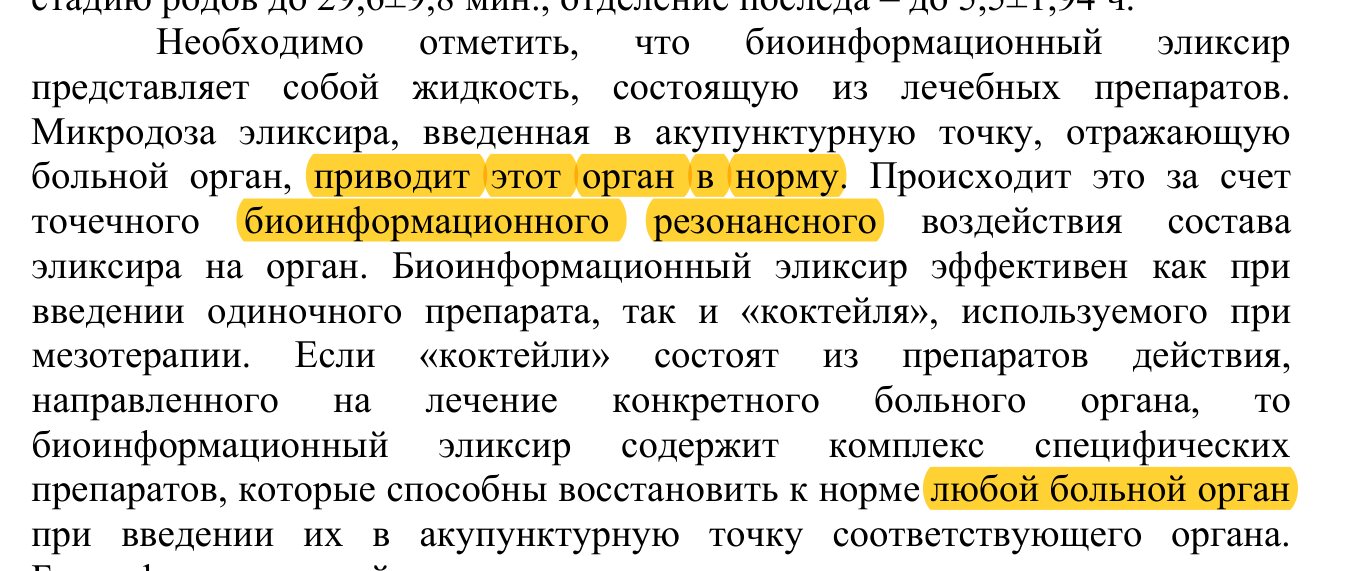
"A microdose of the elixir, injected into the acupuncture point that reflects the diseased organ, brings that organ back to normal. This happens through the point-specific bioinformation resonance action of the elixir's composition on the organ." Микродоза эликсира, введенная в акупунктурную точку, отражающую больной орган, приводит этот орган в норму. Происходит это за счет точечного биоинформационного резонансного воздействия состава эликсира на орган.
"Bioinformation resonance" is not a term from physiology. The paper shows where it came from. The method follows G.V. Kazeev, author of the Russian manual Veterinary Acupuncture (2000) and of work on "information therapy of animal diseases through acupuncture points." The idea is that a drug delivers information as well as molecules, and an acupuncture point routes that information to the right organ.
Hold on to the word information. It comes back.
And what was the box?
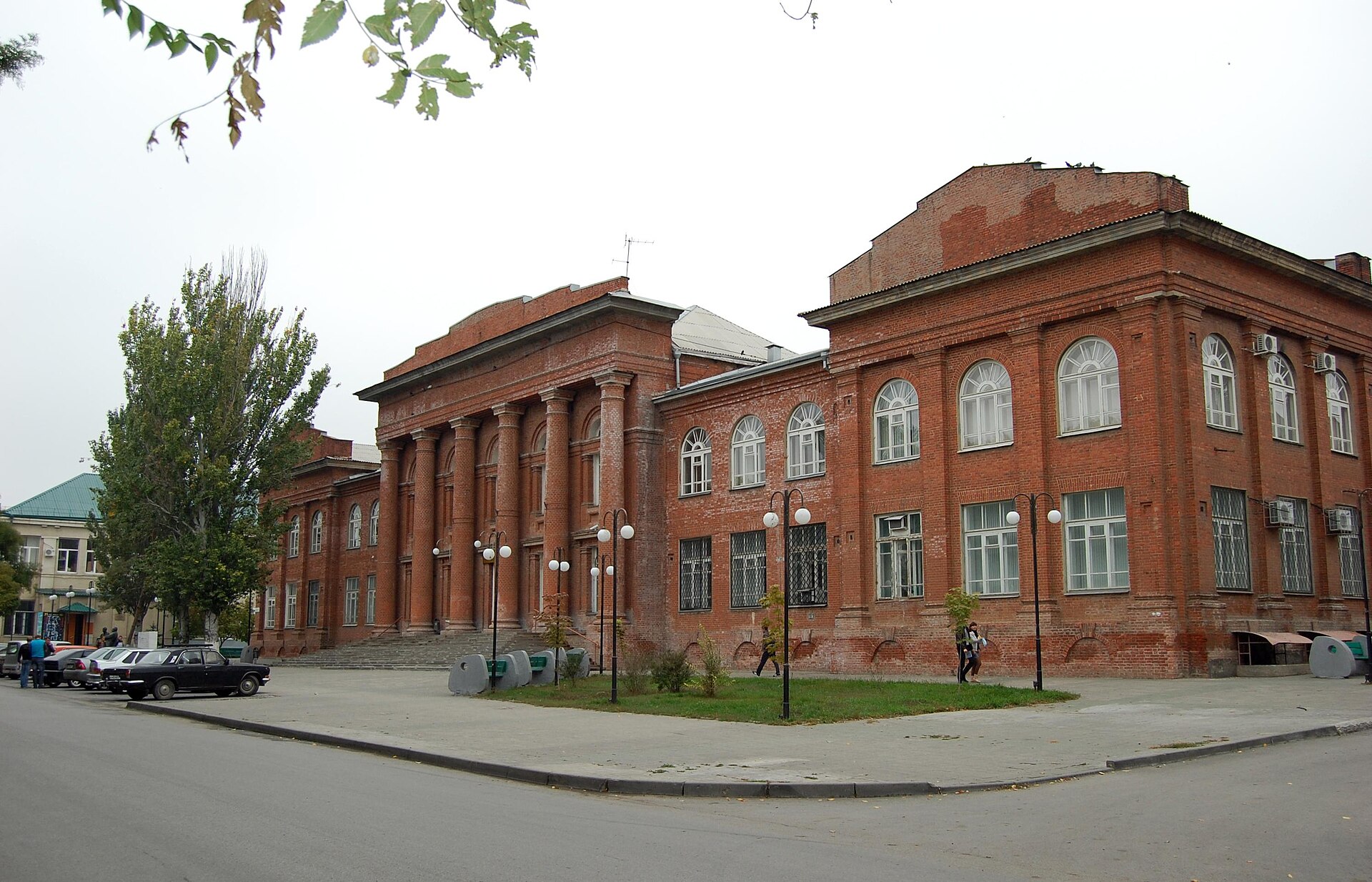
To understand the DiaDENAS you have to go to Taganrog, a port on the Sea of Azov. In the Soviet era it was home to the Taganrog Radio-Engineering Institute, named after V.D. Kalmykov, who ran the Soviet radio industry, the ministry that built radar and electronics for the military. In the 1970s the institute had a small department of medical electronics. By the early 1980s it had become a special design bureau called OKB "RITM," which means "Rhythm."
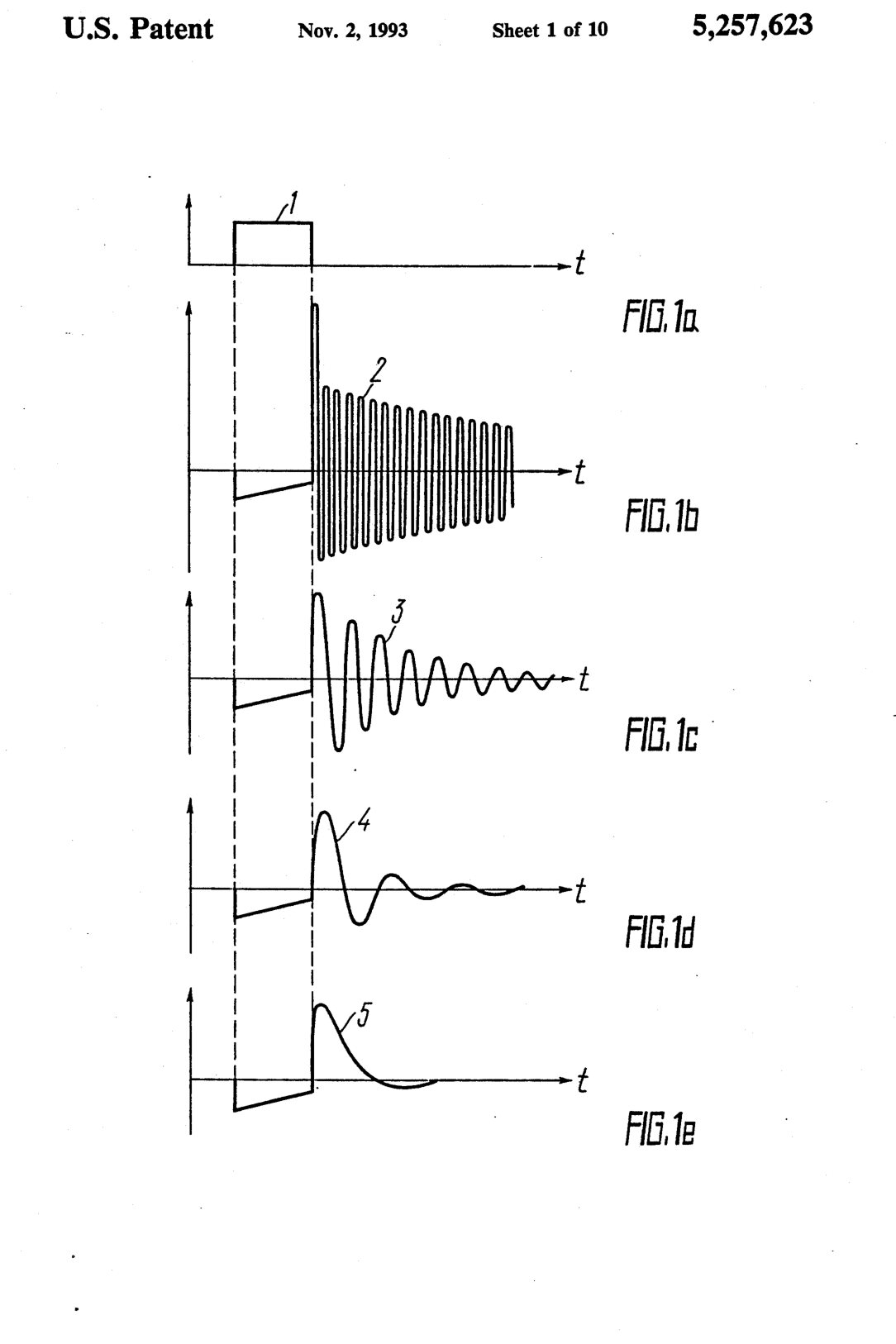
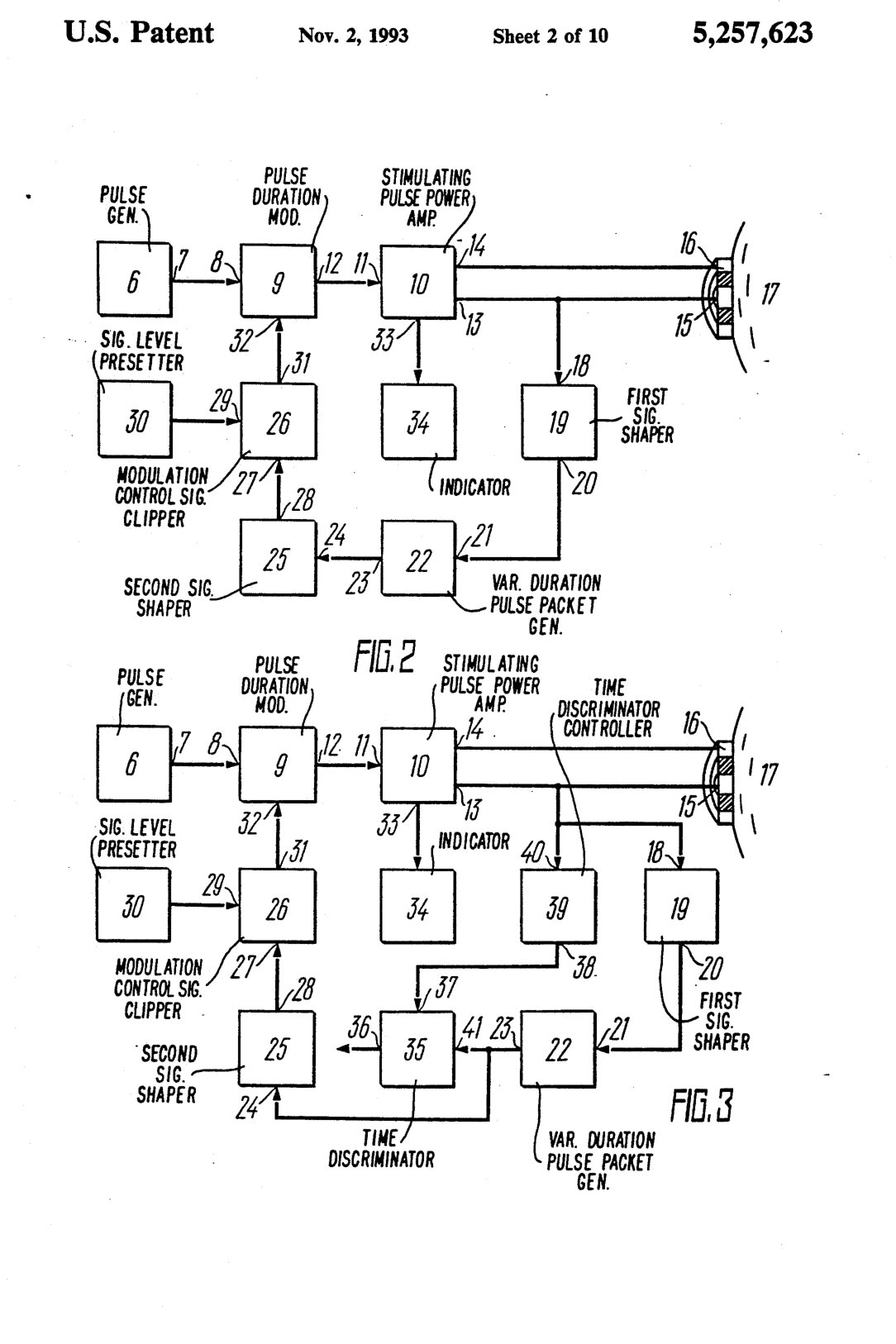
The idea the Taganrog engineers were chasing was straightforward and clever. An ordinary TENS unit, the pain-relief gadget physical therapists stick on your back, sends the same pulses whatever happens. What if the device listened to the skin between pulses and adjusted the next one to what it heard?
The idea is visible in the paperwork. On 4 January 1987 the institute itself filed a Soviet application for an "Electrostimulator," application SU 4171898/14. The inventors were V.G. Zakharevich, A.I. Nechushkin, A.A. Karasev, A.N. Revenko and A.A. Kibirev. The device reads the electrical transient after each pulse. If the tissue responds in a way the inventors associated with pathology, the device cuts the pulse train short.
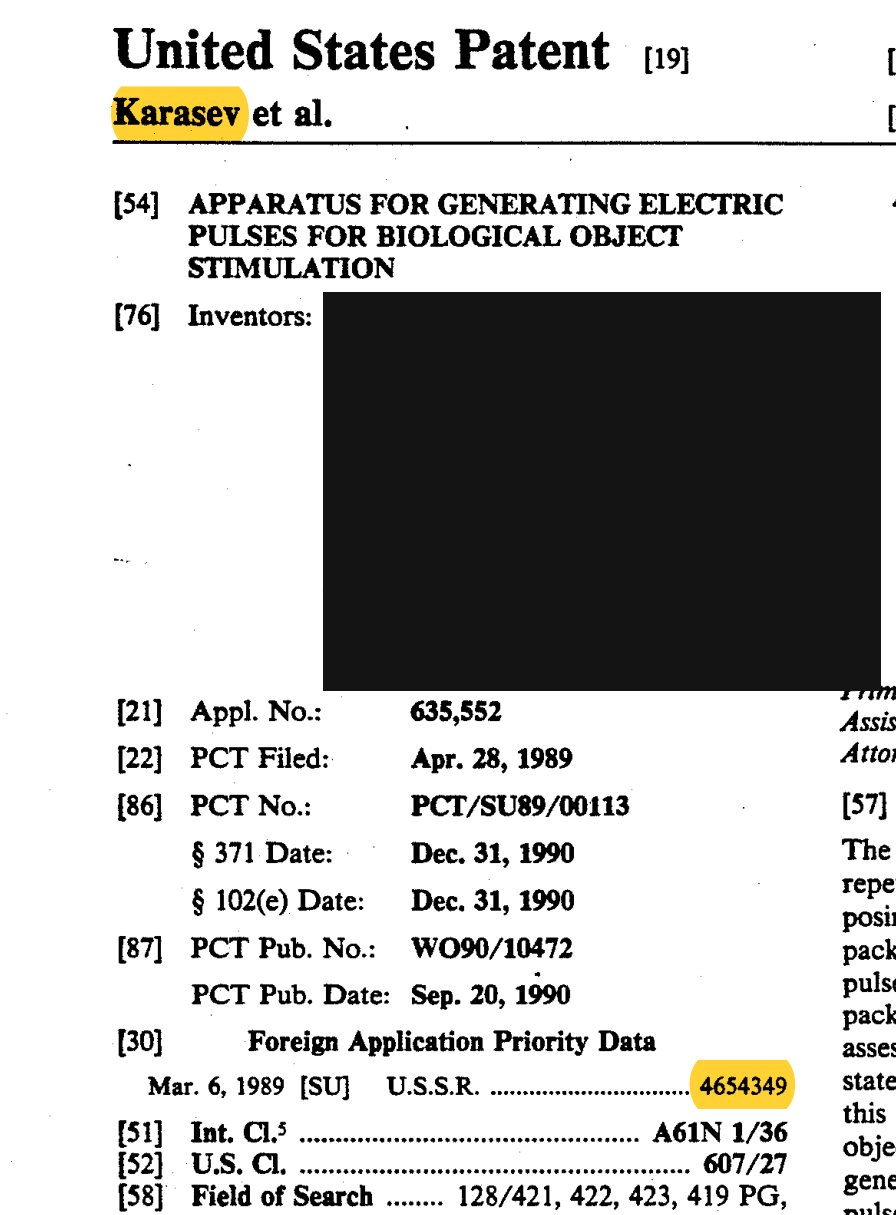
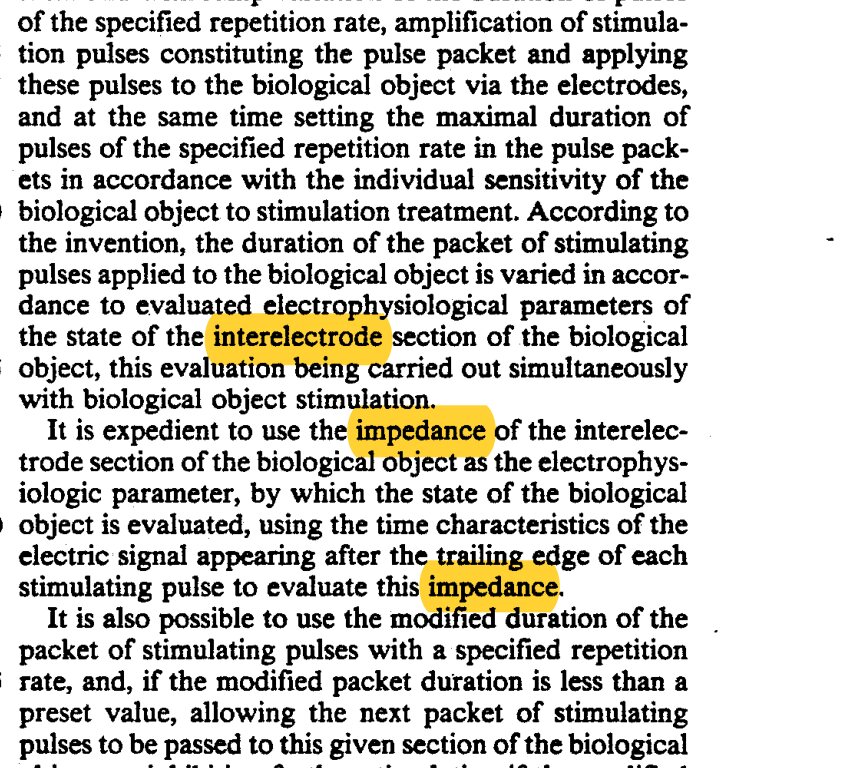
A second application, filed in March 1989, became a US patent in 1993. It states the principle plainly.
That's SCENAR, the Self-Controlled Energo-Neuro-Adaptive Regulator: a TENS unit with a feedback loop. It isn't magic, and as engineering it's rather neat.
The DiaDENAS on that cow is SCENAR's grandchild. In the mid-1990s, as the Soviet Union collapsed and its engineers went into business, a group in Moscow and Yekaterinburg built their own version and called it DENAS. By 2005 "dynamic electroneurostimulation" had a Russian registration as a new medical technology, and a family of devices: DiaDENS-T, DiaDENS-Kardio, DENAS-Vertebra, and versions for vets.
Wait, what about the cosmonauts?
If you've read about SCENAR in English you've probably met the space story: built for Soviet cosmonauts, to treat illness in orbit without drugs.
None of the patents mention space: not the 1987 application, not the 1989 one, not the late-1990s patents. Nor do the excerpts we read from roughly fifty Russian dissertations on SCENAR and DENS.
The space claim lives in vendor copy, and even there it undermines itself. One widely reposted history says SCENAR was "developed for the Russian space program." A few paragraphs later it says: "Ironically, no SCENAR device has been used in space to date," and blames waterproofing delays and the end of the program during perestroika.
At best, some people hoped it would go to space. It didn't.
The paper trail does contain two odd details. The 1987 application wasn't published until 27 August 1995, more than eight years after filing. Soviet inventions with a defence angle were sometimes kept restricted for years, but the gap could also come from converting Soviet applications into Russian ones after 1991. The Russian patent office's site blocks foreign traffic, so we could not check its record.
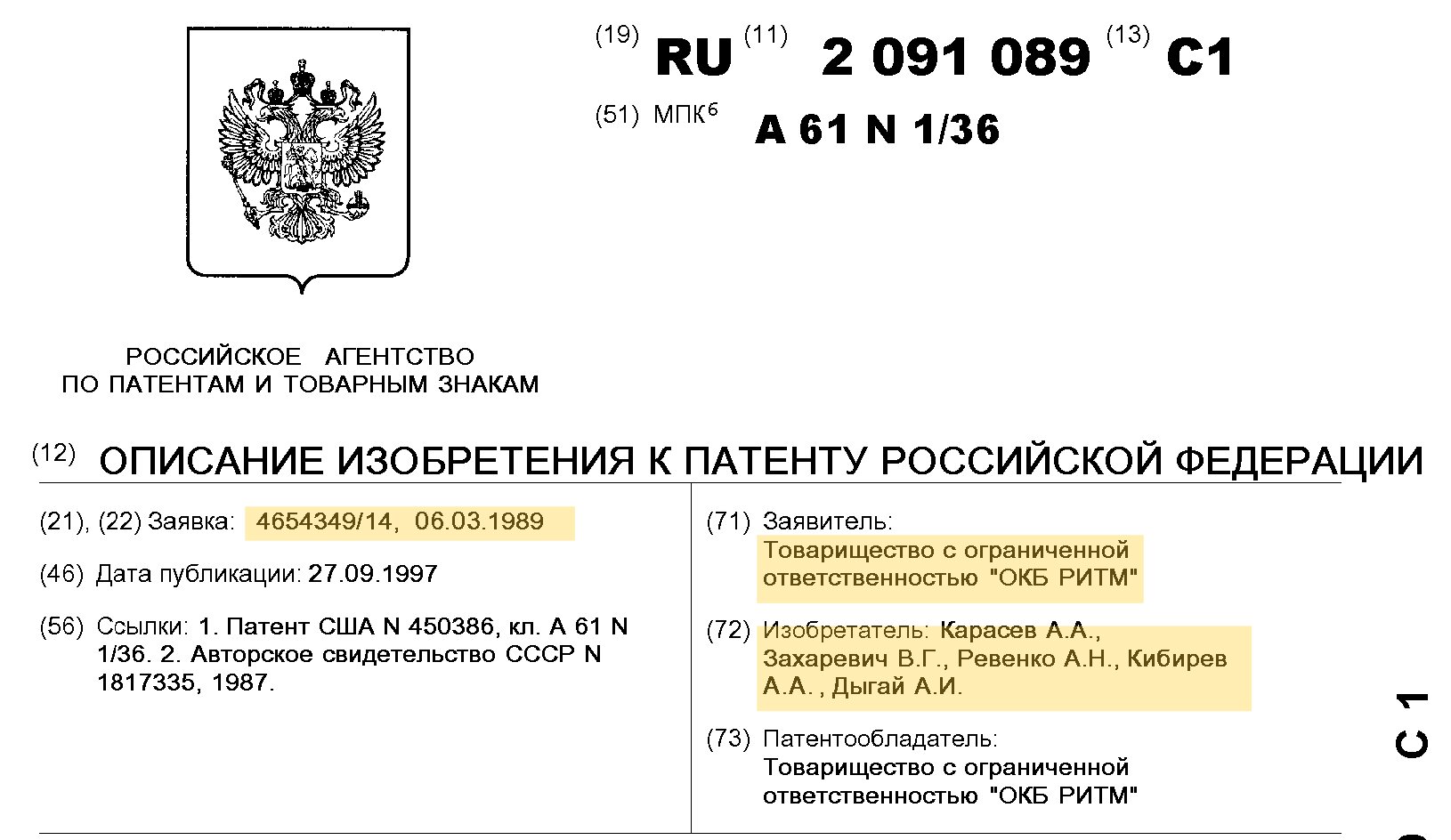
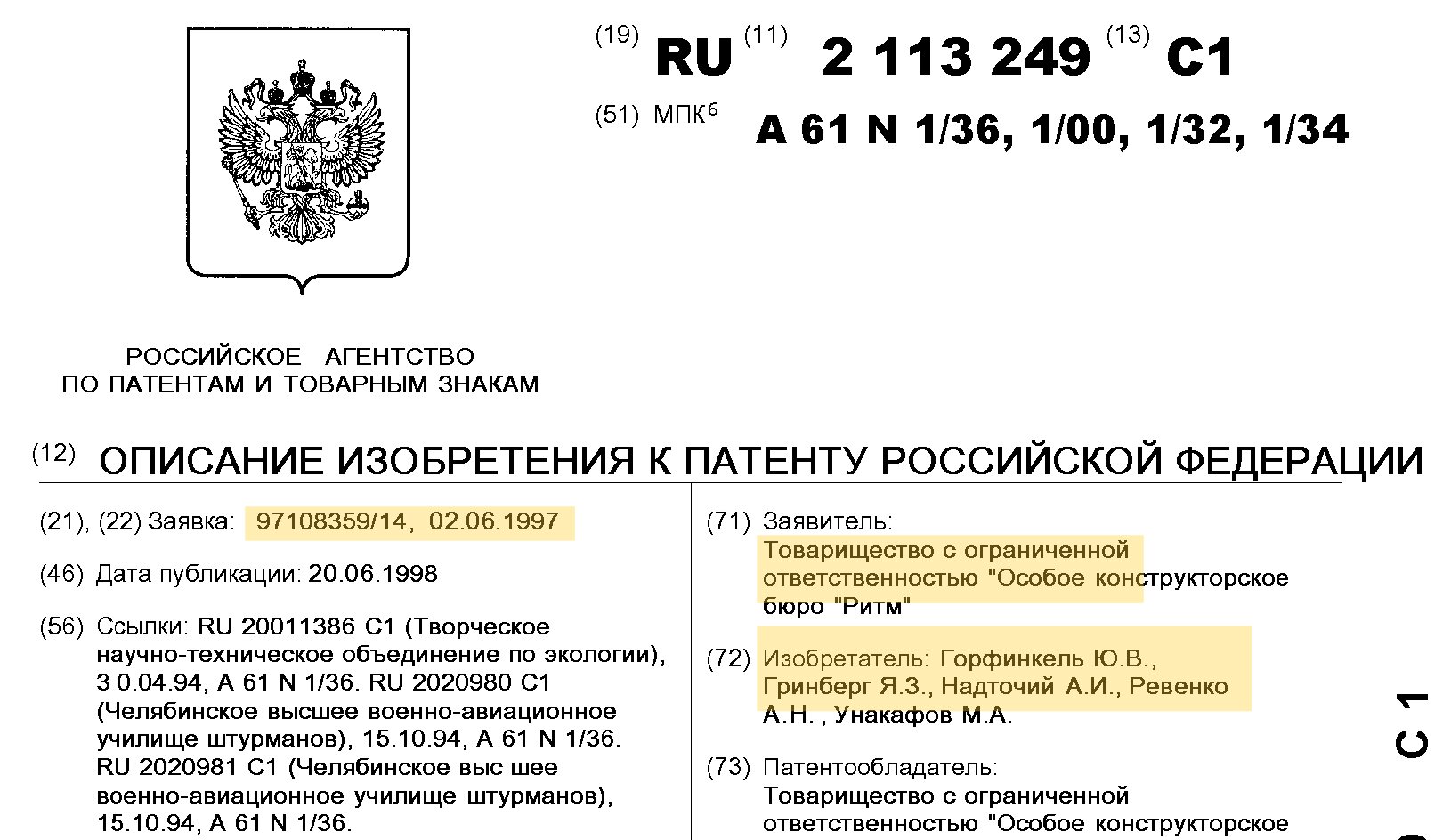
That second detail is Exhibit I. When OKB RITM patented a new stimulator in 1997, the prior art it had to beat included two 1994 electrostimulator patents from a Soviet military aviation school in Chelyabinsk. That shows military institutions were building electrostimulators in the same patent class. It does not show SCENAR was a military or space device. It is still the only military link we found in the documents rather than the brochures.
The founders can't agree on the founding
There are at least three official histories of SCENAR, and they don't match.
The engineer, Alexander Karasev, says he built a Russian TENS device in 1973, tested an early model at a Sochi sanatorium in the mid-1970s, and only gave a device to the neurologist Alexander Revenko in 1983–85. He left in 1990, started his own company, and still sells devices under the SCENAR name.
The neurologist, Alexander Revenko, dates his trials to 1978. He says the device was first called "CENAR" and was renamed SCENAR in 1985 on the advice of, among others, the president of the Russian Acupuncture Association. He writes that Karasev "continues to produce many devices under the name SCENAR, for which he has no permission from OKB RITM," and lists the rivals that split off in 1996, including DENAS, which he credits to "A. Ryavkin."
The company, OKB RITM, says it was founded in May 1980 and signed the first contract to develop SCENAR on 12 December 1986.
The approval date wobbles too. Vendor copy says the Soviet health ministry approved SCENAR in 1986. A 2013 Russian dissertation says approval came in 1991, from the ministry's Committee on New Medical Technology. That dissertation's author is S.Yu. Ryavkin. Keep the surname in mind when weighing who tells which part of the story.
Karasev dates his first TENS device to 1973, but no Karasev or Revenko medical patent before 1987 turns up in the patent databases. The only earlier Soviet certificate the 1987 filing cites is SU 865300 (1979), from a different lab: L.I. Kalakutsky, Kuibyshev Aviation Institute.
None of this means the device is fake. It means the history everyone repeats is a marketing product, assembled after the fact by people running competing businesses.
The boom
Why did this take off in the 1990s? The general director of OKB RITM from 1998 to 2012, Yakov Grinberg, wrote it down.
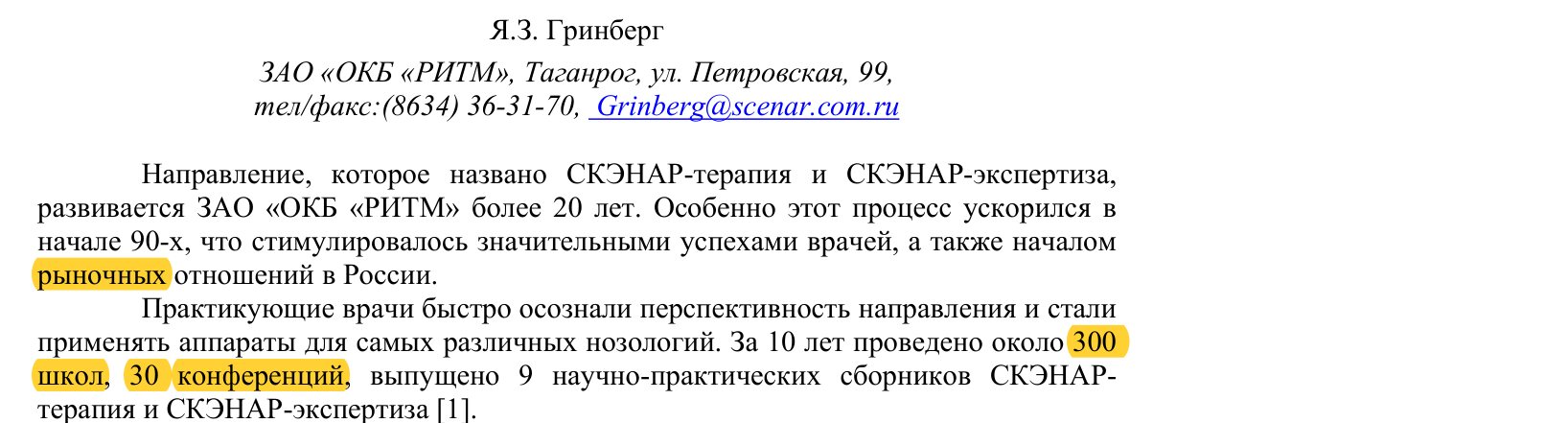
A 2003 conference in Bulgaria drew people from 20 countries. The machine produced a literature to match. By the 2000s there were Russian dissertations pairing SCENAR with almost anything: sleeping pills for insomnia in ambulance doctors, calcium-channel blockers for blood-pressure crises, Arthrofoon (an ultra-diluted antibody drug) for peritonitis. Several came out of one department at Rostov State Medical University. The pattern was always the same: a drug plus the box.
Our veterinarian did the farm version. A Soviet peptide plus the box.
So did it work on the cows?
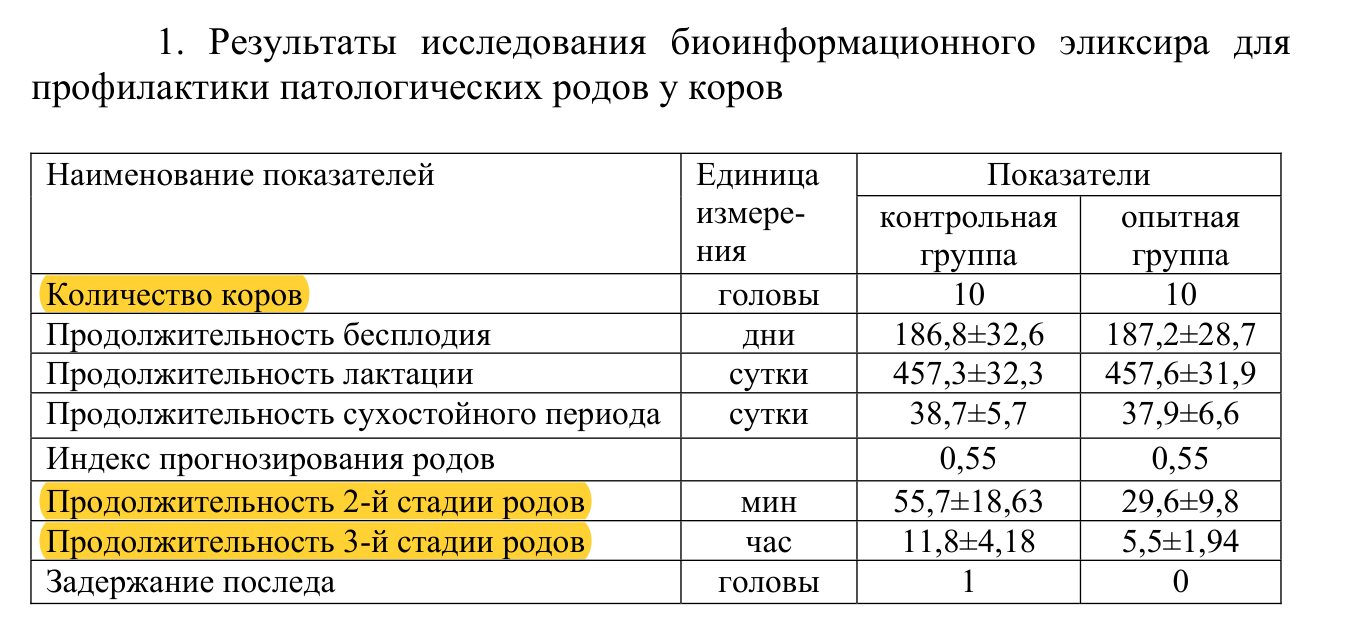
Both groups had ten cows. All twenty were chosen because the author's own forecasting index, published in 2005, predicted a difficult birth.
| Measure | Control (farm care) | Elixir + DENAS |
|---|---|---|
| Cows | 10 | 10 |
| Stage 2 of labour (delivering the calf) | 55.7 ± 18.6 min | 29.6 ± 9.8 min |
| Stage 3 (expelling the placenta) | 11.8 ± 4.2 h | 5.5 ± 1.9 h |
| Retained placenta | 1 | 0 |
On its face that is a big effect: labour roughly halved. Now look at what the paper doesn't report. It doesn't say the cows were randomly assigned. It doesn't say whoever timed the births was blinded. There is no group that got the elixir without the box, or the box without the elixir, and no fake box. And twenty animals is too few to rule out chance.
Even if the difference is real, there is no way to tell whether it came from the thymus extract, the frog-descended distillate, the current, the extra handling the treated cows got, or chance.
The toxicology is real, for what it's worth. A federal animal-safety centre in Kazan classed the elixir as low hazard, non-irritating and non-allergenic. That tells you it probably didn't hurt the cows. It doesn't tell you it helped them. And "bioinformation resonance" restoring "any diseased organ" is not a hypothesis anyone can test.
What does better evidence say about the box?
Outside cow barns, SCENAR and its relatives have been tested more rigorously. The results are mixed.
| Trial | Design | Result |
|---|---|---|
| France 2021 · SCENAR · back and neck pain | Sham device, single session, 60 patients | Both groups improved; no significant difference (p = 0.22). Gone by the next day. |
| Spain 2023 · SCENAR (OKB RITM) · overactive bladder | Sham, single-blind, 66 patients | 70% vs 48% responders (p = 0.014). |
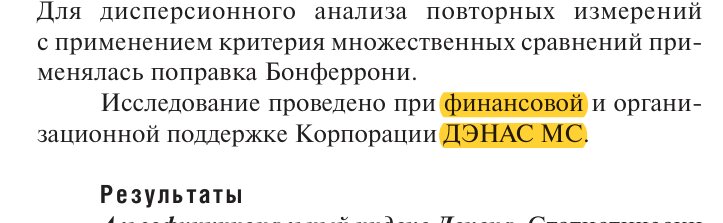
| Russia 2015 · DENS · knee arthritis | Double-blind, inert look-alike device, 132 patients | Joint-function score improved only with the real device. Funded and organised by the manufacturer. |
| USA 2019 · Tennant Biomodulator · chronic pain | Open label vs TENS vs acupuncture, 100 patients | All three about equal; gains mostly gone within a month. |
That is roughly what you'd expect from a clever TENS unit: some real effect on some kinds of pain and nerve-related symptoms, a large placebo cloud around it, and little independent replication.
The most candid assessment comes from inside the company. In the same 2004 paper, Grinberg, then running the firm that makes SCENAR, listed his conclusions.

The information signal. There's that word again.
Why this matters
It's tempting to file this under weird Russian cow science and move on. But the cow study is a near-perfect specimen of how a certain kind of medicine gets built, and it's how many wellness products still reach you.
You start with something real. A feedback-loop stimulator from Taganrog is a legitimate idea. A calf-thymus extract is a real biological product with a real, if murky, research history.
You wrap it in prestige: military medicine, the space programme, "developed for cosmonauts."
You add a word that sounds like science but can't be falsified: bioinformation, resonance, adaptive regulation of the whole organism.
Then the Soviet Union collapses, a market opens, and the idea spreads through training schools, conferences and practitioner networks instead of the slow grind of controlled trials. Each practitioner adds a combination: the box plus a drug, the box plus acupuncture, the box plus an elixir. Each combination gets its own small, uncontrolled study, often a dissertation. The literature grows enormous. The evidence doesn't.
Thirty years later, some of these products reach Western buyers with the mythology intact and the dissertations untranslated.
The twenty cows didn't ask for any of this. They had their calves, faster, if you believe one small unblinded study. That, in the end, is the problem.
The record, claim by claim
| Claim in circulation | What the record shows | Verdict |
|---|---|---|
| SCENAR adapts its pulses to the skin's response. | 1987 filing SU 4171898/14; US 5,257,623 names interelectrode impedance explicitly. | Documented |
| It was built for the Soviet space programme. | No patent or thesis excerpt mentions space. Vendor copy concedes no device flew. | Unsupported |
| The USSR health ministry approved it in 1986. | Vendor: 1986. Company: development contract 12 Dec 1986. Ryavkin 2013 thesis: approved 1991. | Disputed |
| The 1987 invention was classified. | Filed 04.01.1987, published 27.08.1995. Russian patent office record not reachable. | Unknown |
| Karasev invented it in 1973. | No pre-1987 Karasev medical patent found. Prior art cited: a 1979 Kuibyshev Aviation Institute certificate. | Memoir only |
| It has military links. | RU 2113249 (1997) cites two 1994 patents of the Chelyabinsk Higher Military Aviation School of Navigators. | Adjacent only |
| Elixir + DENAS halves labour in cows. | Twenty cows, no stated randomisation or blinding, no sham, no single-component arms. | Not shown |
| SCENAR beats sham. | One negative sham trial (France), one positive single-blind (Spain). The positive DENS trial was funded by the maker. | Mixed |
| It works by an "information signal." | OKB RITM's own director, 2004: no evidentiary support. | Unsupported |
Timeline
Sources: patents and registries (P), dissertations and journals (T), vendor histories and memoirs (V).
| 1947 | ASD created by A.V. Dorogov at the All-Union Institute of Experimental Veterinary Medicine. V |
| 1973–75 | Karasev's account: first Russian TENS; ENS-01 tested at a Sochi sanatorium. V |
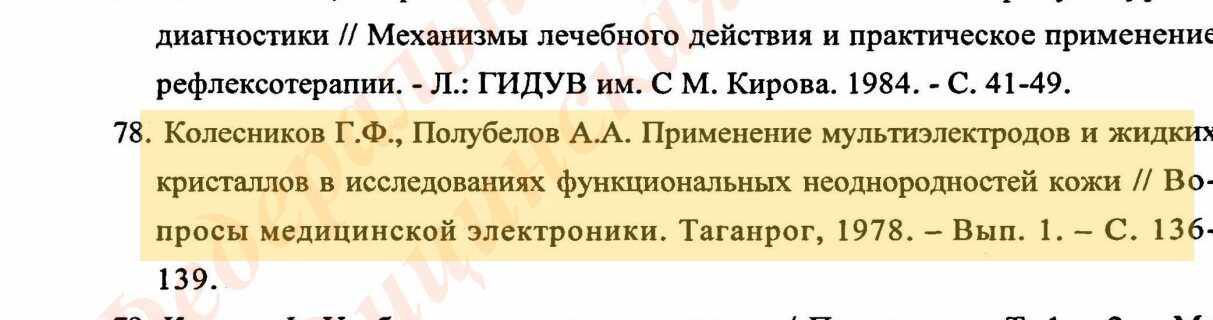
| 1977–78 | Kolesnikov and Polubelov map "functional heterogeneities of the skin" with multi-electrodes, Voprosy meditsinskoi elektroniki, Taganrog (Exhibit N). T |
| 1979 | SU 865300, electrostimulator, Kuibyshev Aviation Institute. Later cited as the prior art to beat. P |
| May 1980 | Design bureau founded at the Taganrog institute; becomes OKB RITM in 1981 or 1983, depending on who tells it. V |
| 1985 | "CENAR" renamed "SCENAR" (Revenko). V |
| 12.12.1986 | First SCENAR development contract signed (company history). V |
| 04.01.1987 | "Electrostimulator" filed by the Taganrog Radio-Engineering Institute. Published only on 27.08.1995 as RU 1817335. P |
| 06.03.1989 | SU 4654349 filed; becomes US 5,257,623 (1993) and RU 2091089 (1997, owner OKB RITM). P |
| 1990–91 | Karasev leaves and founds his own company. A 2013 thesis dates ministry approval to 1991. V |
| 1996 | Splinter devices appear, DENAS among them. V |
| 1997 | RU 2113249 and RU 2135226 filed (Gorfinkel, Grinberg, Revenko and others). P |
| 2004 | Grinberg: most efficacy hypotheses lack evidentiary support. T |
| 2005 | Dynamic electroneurostimulation registered as a new medical technology (FS 2005/004). P |
| 2010 | Gavrilenko: elixir + DiaDENAS in twenty cows, Kazan journal. DVM dissertation follows in 2011. T |
| 2021–23 | Sham-controlled SCENAR trials in France (negative) and Spain (positive). T |
Pharmakon
A publication, not a treatment. Nothing here recommends any product for any animal or person. Highlights on the documents and the covered addresses in Exhibit D are ours.
Primary documents
- Gavrilenko N.N. Application of the bioinformation elixir for prophylaxis of pathological births in cows. Uchenye zapiski Kazanskoi GAVM 203 (2010): 63–68. Elixir composition from his 2011 DVM dissertation (disserCat excerpt).
- RU 1817335 C (appl. SU 4171898/14, filed 04.01.1987, publ. 27.08.1995; Taganrog Radio-Engineering Institute).
- US 5,257,623 (priority SU 4654349, 06.03.1989; granted 02.11.1993). RU 2091089 C1. RU 2113249 C1. RU 2135226 C1. SU 865300 A1.
- Grinberg Ya.Z. On one effect of SCENAR exposure. Izvestiya TRTU, 2004.
- Ryavkin S.Yu. Dissertation, 2013 (approval date; DENAS history).
- Timoshevsky S.V. Dissertation, 2004, ref. 78 (FEMB RUCML-BIBL-0001358275).
- Michel-Cherqui M. et al. J Clin Med 2021;10:5570 (PMID 34884273). Neuro-adaptive electrostimulation vs sham for overactive bladder, J Clin Med 2023 (PMC9917375). Lesnyak O.M. et al. Nauchno-prakticheskaya revmatologiya 2015;53(3):281. Peacock K.S. et al. Mil Med Res 2019;6:37 (PMID 31791416).
- Karasev, Revenko and OKB RITM company histories: vendor accounts, treated as claims.
Images
- Cover: Soviet matchbox label, Kazakh SSR series, "Meat and dairy farming," Pobeda match factory, Penza sovnarkhoz. Dated c. 1957–65 from the GOST 1820-56 mark and the sovnarkhoz name printed on it (Commons lists it as c. 1940s). Public domain, via Wikimedia Commons; upscaled by Pharmakon.
- Exhibits A–N: page crops from the documents above, used for criticism and review.
- Taganrog Radio-Engineering Institute, Building A. Anna Astakhova, 2011, CC BY-SA 3.0, via Wikimedia Commons.
Could not verify
Whether the 1987 application was restricted, and the full text of the 1977–78 Taganrog skin-mapping paper. If you hold either, write to us.